
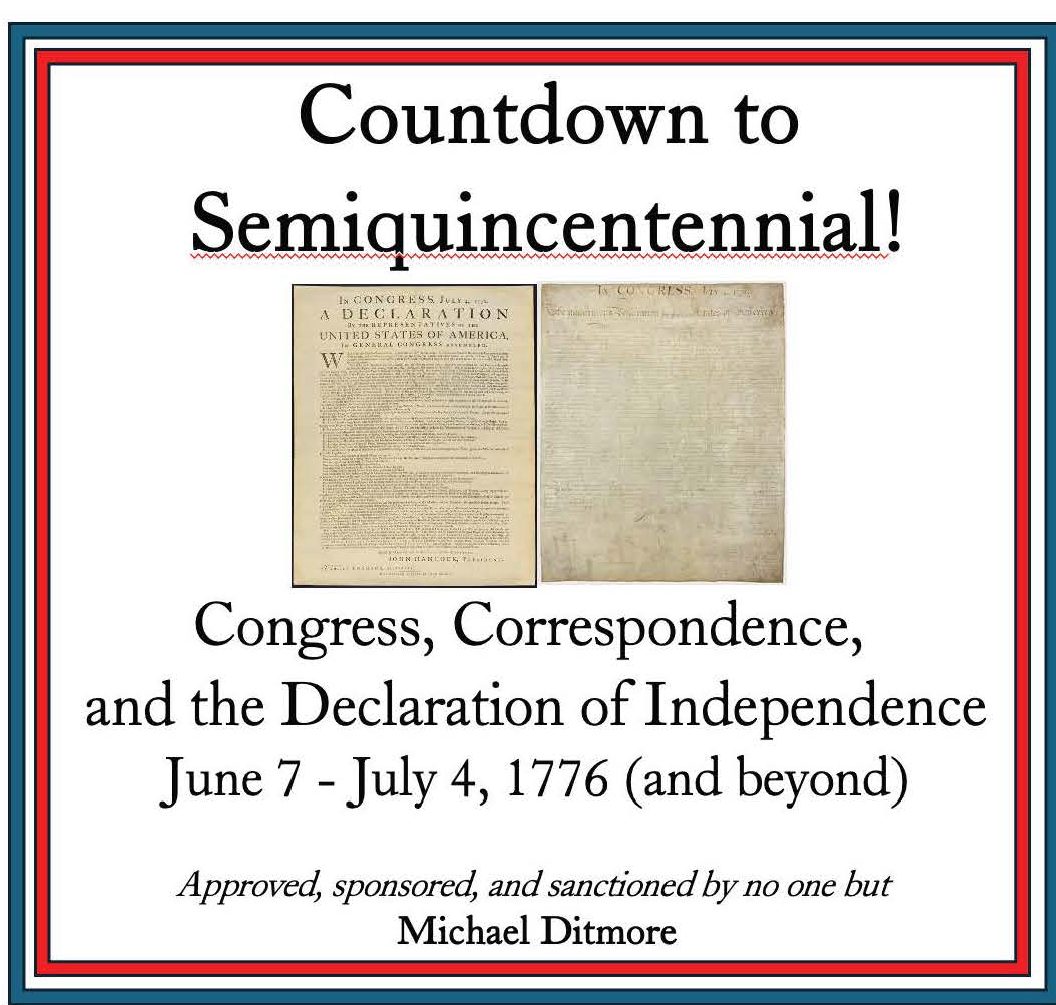
 After a three-week hiatus (and a weekend), Congress resumed its debate on the proposal for independence on Monday, July 1, 1776. The proposal had been first introduced on Friday, June 7, by Richard Henry Lee and then, after two days of debate, it was tabled on Monday, June 10. The reported Declaration draft would be sitting quietly in place on the physical table while Congress resumes its discussion.
But they would not resume until they had run through other business, such as a brief listing of letters received and an account to be settled. The major news, though, came from the convention of Maryland. On June 28, the same day that the Declaration draft was submitted, the Maryland convention had agreed unanimously to instruct its delegates to support independence for the United Colonies. Thomson recorded the resolution itself in full; this marked the first official notice in Congress of Maryland’s change.
And then the debate resumed, in a committee of the whole “to take into consideration the resolution respecting independancy,” Benjamin Harrison presiding. But, as usual, Thomson’s generally minimalist record-keeping gives us little to work with – he describes no interruptions, no sharp words, no guffaws, no cheers, no gasps, if there were anything of the sort. All we can glean from the journal for the day is that the committee of the whole had agreed to an (undescribed) resolution but that its “determination” would be postponed until the next day “at the request of a colony.”
What? A single colony requested postponement? Which one? Why?
This can be sorted out, but we’ll have to go outside of the journals and even outside of the time frame to have a better idea of what transpired on July 1. And that will take us to yet another complicated Founder, John Dickinson of Pennsylvania.
Before turning there, I should also mention Thomas Jefferson’s untitled “Notes of Proceedings in the Continental Congress,” a 20-page document that he had prepared by 1783 that gives a much more detailed picture of Congress’ official proceedings concerning the independence debate for the month of June.
Although Jefferson’s account is far more detailed than anything in Thomson’s journals, it also lacks certain details. It gives us a general account of the pro and anti groups, with names and particular positions, in the June 8 and 10 debates. But it skips from June 11, when the Declaration drafting committee was formed and he was chosen as drafter, to June 28 when it submitted the draft.
Jefferson also gives us scanty details of the Monday proceedings, except to note that after debate the resolution remained opposed by South Carolina and Pennsylvania, that Delaware’s vote remained split between its two delegates, and that the New York delegation felt bound by its instructions to abstain. But then: “Mr. Rutlege of S. Carolina then requested the determination might be put off to the next day, as he beleived (sic) his collegues, tho’ they disapproved of the resolution, would then join it for the sake of unanimity.”
So, we hear from Edward Rutledge of South Carolina again. Rutledge had originally proposed tabling the resolution for three weeks on June 10, and now he sought postponement again, arguing unanimity could be achieved overnight – somehow.
But on July 1, even after all the shifting of the middle colonies (including the report of Maryland that very day), Congress still could not reach unanimity on independence. In fact, it would barely meet the minimum nine delegations for approval as things now stood: South Carolina and Pennsylvania were opposing; Delaware was divided, and New York was abstaining.
What was the hold-up? What arguments were exchanged in the July 1 debate? Jefferson’s Notes give us no hints. For that, we will need first to turn to Jefferson’s partner in independence, John Adams – as well as we can.
Before Congress met that morning, Adams wrote a letter to his friend in Georgia, Archibald Bulloch, apprising him of debate that would resume that day. He was confident that the resolution would be approved and then prayed, “May heaven prosper the new born Republic – and make it more glorious than any former Republics have been.”
But after the day in Congress, Adams wrote to Samuel Chase with some impatience and disgruntlement, dismissing the debate as “an idle Mispence of Time for nothing was Said, but what had been repeated and hackneyed in that Room before an hundred Times, for Six Months past.” He reported the postponement and expected that the resolution would pass the following day – although there was still some uncertainty.
To drill deeper, we’ll need to fast forward some 30 years with cranky, hypersensitive Adams, starting with the unfinished “autobiography” that he worked on from 1802-1807 (which remained unpublished until 1856). As he came to events late in 1775, Adams perhaps realized that his memory and few notes alone could use some assistance, and so he began consulting Thomson’s printed Congress journals – and that’s also when he began to complain about Thomson’s very lean manner of recording what happened. And yet, he also fell back to quoting the journals verbatim – which is exactly what he did for Monday, July 1.
In his autobiography, Adams went on to pinpoint “Mr. Dickinson” as the principal opponent of independence on July 1, even though the cause seemed pointless:
Mr. Dickinson however was determined to bear his Testimony against it with more formality, He had prepared himself with great Labour and ardent Zeal, and in a Speech of of great Length, and all his Eloquence, he combined together all that had before been written in Pamphlets and News papers and all that had from time to time been said in Congress by himself and others. He conducted the debate, not only with great Ingenuity and Eloquence, but with equal Politeness and Candour: and was answered in the same Spirit.”
FWIW, Adams and Dickinson had already gotten crossways more than once the previous year, one time involving an intercepted and then published Adams letter in which he not only violated Congress’ secrecy rule but candidly dismissed Dickinson as no more than a “piddling genius.”

Portrait of John Dickinson by Charles Willson Peale. Public domain photo from Wikimedia Commons.
While we don’t know exactly what Dickinson’s July 1 speech consisted of, we do have some idea of its substance and tenor from manuscript notes he left behind – and, although sketchy and incomplete, they are well worth a reading. Dickinson was well aware the damage to his public reputation his opposition would cause, and he prayed before beginning.
If the notes are any indication, Adams was right: Dickinson was no hothead. In fact, Dickinson hints that one of the ways made his own decisions was to gauge the passion of the different sides – and to choose the side least driven by passion. He even says at one point, “I am alarm’d at this Declaration being so vehemently prest.”
But Adams is also probably right, that Dickinson introduced no new arguments or information; his concerns were largely prudential and practical, if cautious – and also reasonably informed. He had deep worries about complicated foreign relations, entanglements, bridges crossed. And about the Americans themselves, who still did not know and trust each other sufficiently:
Not only Treaties with foreign powers but among Ourselves should precede this Declaration.
In the end, Dickinson worried that being in a state of war, being engaged in “so wretched a State of preparation,” and when they couldn’t be sure of the allies they were hoping to attract – altogether, he thought that their decision-making would be clouded and hasty. You can read Dickinson’s notes i Paul Smith’s edition of Letters from Delegates in Congress.
According to Adams’s memory, no one responded when Dickinson ended his speech. Finally, Adams himself spoke in reply – but couldn’t recall later much about what he said. Oddly, however, as he was finishing, new delegates from New Jersey had arrived and “expressed a great desire to hear the arguments,” so, despite reluctance (but with encouragement from Edward Rutledge), he repeated what he thought was a well-worn argument – again.
Adams returned to this memory in an August 1807 letter to Mercy Otis Warren, a close family friend who published a three-volume History of the Rise, Progress, and Termination to the American Revolution. Adams’s vanity never allowed him to resist setting the record straight about himself, and so he devoted several letters that year to Warren to dispute, with vehemence, certain Adams details and matters – and in great detail. And to be fair, Warren’s history plays fast and loose with details at times, a quality not to be unexpected in a history written so close to the events. In the passage Adams objected to, she begins with the Lee resolution for independence, seconded by Adams, and then has Dickinson object with his July 1 speech – followed by Adams’ July 1 speech.
Warren’s confusion seems also to have confused Adams, who objected mainly to her description of him literally “invoke[ing] the God of Eloquence” (a phrase she must have picked up elsewhere; from there, Adams seems to be able to recall at least a part of his own speech with some detail – because, wanting to set the record straight, it was not that Adams invoked a pagan deity only to be corrected by Dickinson’s pious prayer, but it was the other way around – Dickinson prayed, yes, but Adams “did not think it necessary in that assembly to make an ostentation of Piety by a Solemn Prayer.”
But who was John Dickinson? We don’t have time or space to address a very good question here, except to say that Dickinson had been a major contributor to the American resistance by authoring a series of essays protesting the Townshend Acts, serialized in newspapers in 1767-1768 and gathered under the title Letters from a Farmer in Pennsylvania, To the Inhabitants of the British Colonies in 1768. It was perhaps the most potent and influential public protest against Parliament’s actions before Thomas Paine’s Common Sense.
Dickinson was firm but moderate: Parliament has no right to tax the colonies in any form without their consent – and yet he also stops short of suggesting anything like outright separation or independence. Instead, he believed in colonial dependence on the mother country to the mutual benefit of both – and in the end, that was the stance he stuck in his speech on July 1, even though he must have known by that time that he was in a shrinking minority. Given all that had happened over the past 15 months, and the severity of the breach and unlikelihood of reconciliation, it did seem like it was only a matter of time before the breach was made permanent.
And so – independence had to wait at least one more day, along with the (presumably) patient Declaration. But as we too wait, it is worth pondering on the complexity of character like John Dickinson, who was no less outspoken or disgruntled about how the British were mistreating the Americans and yet who was still unready to move forward with Adams and others. We have seen several such complex figures just in these posts – New Jersey Governor William Franklin, body servant Robert Hemmings, South Carolina’s Edward Rutledge. The next step, though … would entail its own chain of consequences.
Countdown to Semiquincentennial: Number 25, July 1
By Michael G. Ditmore
0 Comments