
 On July 2, 1776, the Continental Congress gathered to vote on whether or not to declare independence from Great Britain. More than three weeks had passed since Richard Henry Lee had first proposed voting on the issue; during that time, Thomas Jefferson and an appointed committee had drafted a whole declaration about independence, and that declaration was now sitting in front of Congress as they debated.
Congress had postponed a vote on “the question of independency” the day before, in part because of John Dickinson’s informed and thoughtful speech opposing the vote. Also, it seems clear that Congress put off the vote one more day because it was trying to ensure a unanimous vote in favor of independence. Although a sufficient majority of colonies were ready to vote in favor of independence, four states were not: South Carolina and Pennsylvania were opposed; Delaware’s two delegates were split; and the New York delegates had been ordered to abstain.
On July 2, the New York delegation sent a letter to its Provincial Congress, pleading for a change to its instructions. They pointed out that it would pose considerable “Doubts and Difficulties” if every colony except New York approved independence. It was a good letter, but the New York Provincial Congress was delayed by the threat of the arrival of British troops, so it would not address the vote on independence until July 9. It supported the move for independence at that point but was a week late for the big vote!
But Delaware did not delay when it became apparent that its delegation was at a stalemate between Thomas M’Kean– for independence–and George Read–against. M’Kean sent an express message to Caesar Rodney in Dover, and Rodney made a 70-mile overnight ride to Philadelphia to arrive in time to break the tie and ensure that Delaware would vote for independence.
But you would never know any such drama was occurring if you only read the reports from Charles Thomson. His journals for Congress on July 2 begin with communications from General Washington, the council of Massachusetts Bay, and Connecticut Governor Trumbull, and a letter from a British officer saying his troops captured during a naval battle in Boston had “experienced the utmost civility and good treatment.”
When Thomson finally gets around to the big business of the day, his entry is is so understated it would be easy to overlook: “The Congress resumed the consideration of the resolution reported from the committee of the whole, which was agreed to …”
Surely there was more to record than that about the crucial vote for independence! Was there no further debate or jostling? Not even a mention of Rodney’s 70-mile ride to sway the Delaware vote?
Another crucial event we don’t read about in Thomson’s report but know from other sources involves Dickinson, who had made his last-ditch opposition speech the day before. On July 2, Dickinson abstained from voting; he might not have even showed up to the debate — sources aren’t clear on that. Another Pennsylvania delegate, Robert Morris, also abstained, thereby allowing Pennsylvania to vote for independence.
In addition, delegates from South Carolina shifted their opinion overnight and approved the resolution for independence on July 2. The shifts from South Carolina, Pennsylvania, and Delaware allowed the Congress to declare a unanimous verdict for independence. True, New York had not supported the resolution, but it had not voted at all, thus allowing the claim that there was unanimity among all the voting delegations. And New York ultimately joined the vote for independence a few days later.
That leads us to one of THE most significant documents in all of American history, although it looks like little more than secretarial scrap paper – which it is, actually. If we are looking for THE pivotal, Ground Zero inception instant of the United States of America – here it is!
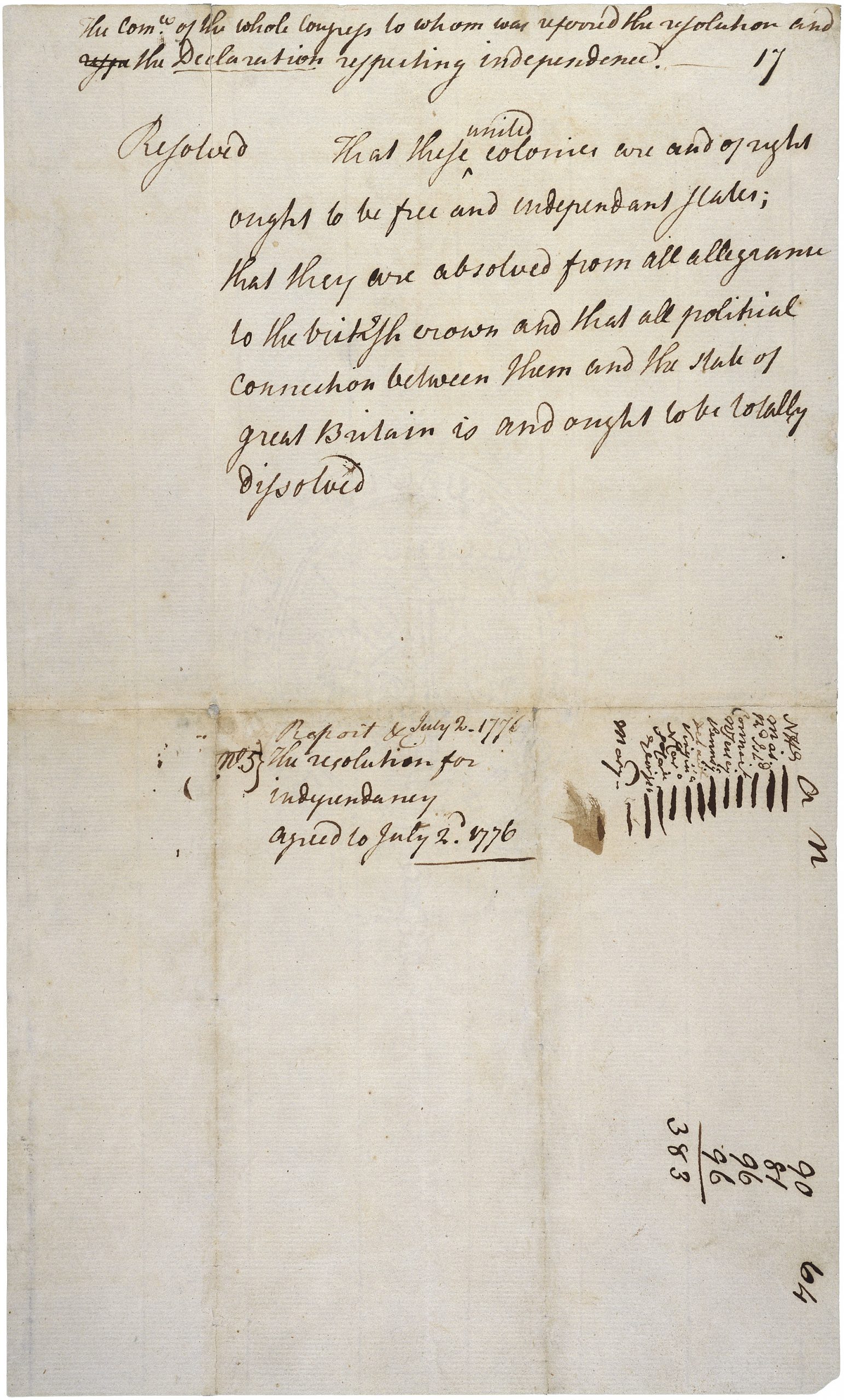
This document records the July 2, 1776, vote in which the Continental Congress agreed to independence. It is part of the “Papers of the Continental Congress,” held by the National Archives.
Written in his handwriting, presumably, Thomson used this copy to read the words of the June 7 Lee resolution for independence at the beginning of the Monday debates (unintentionally omitting “united” and interlineating it later). But that’s only part of the significance.
Thomson had folded the page in half, and later folded it twice more, but if we turn it sideway to the left we will see a tally of the delegation voting, listed under “a” (fa or “aye”) and “n” (for “nay”), starting with New Hampshire (“NHS”) and proceeding southward to Georgia – and then back up to Maryland – unamimous!
(The extra “a” mark probably was for abstaining New York. I have no idea what the calculation of numbers refers to, except to say that the addition is incorrect. The result should be 363.)
At any rate, without comment or drama, Thomson recorded in the journal the exact wording:
Resolved, That these United Colonies are, and of right ought to be, Free and Independent States; that they are absolved from all allegiance to the British crown, and that all political connection between them, and the state of Great-Britain, is and ought to be totally dissolved.
And THAT is THE kernel of American independence, in whole. While it needed to be announced to the world in a more formal declaration, independence had been accomplished with the closing of the committee of the whole and its report to Congress.
Although Congress was relatively successful in preventing leaks, this news naturally would have been especially difficult to contain. And in fact, the following notice appeared in that afternoon’s Pennsylvania Evening Post:
This day the CONTINENTAL CONGRESS declared the UNITED COLONIES FREE and INDEPENDENT STATES.
That leakage then appeared in five more newspapers (two of them German language) over the next three days, even before news of THE Declaration appeared!
But there is a catch, of sorts. We’ll recall that the reported Declaration draft had been sitting on the table in Independence Hall during the debating and voting of the previous two days, although we have no record that anyone referenced it. For all the things that the draft said and did, it did NOT include the exact words of the resolution for independence that were unanimously approved by Congress on July 2.
Keep that in mind.
But, having agreed to independence, Congress continued to its next order of business: again resolving itself into a committee of the whole to take “under consideration the declaration” referred to to them the previous Friday (five days earlier). Whatever happened after this move, the committee of the whole reached no definite conclusion and so would need to meet on the matter again the next day.
But we have a good idea of what they began doing on July 2. They began editing the Declaration draft that had been tabled. We just don’t know very well how they went about editing with some 50+ delegates at one time.
For now, though, let’s celebrate a truly momentous occasion – American independence became reality on July 2, 1776!
Countdown to Semiquincentennial: Number 26, July 2, 1776
By Michael G. Ditmore
0 Comments