
 As already noted, Congress always adjourned on Sundays, and often on Saturdays, so there are no official proceedings for Sunday, June 30, 1776. Even the correspondence is fairly bare – and unrelated to independence or to the Declaration.
John Adams wrote a longish letter to Cotton Tufts, a cousin-in-law and doctor in Massachusetts, taken up entirely with the various manufactures and materials need for conducting a war: a foundry, muskets and bayonets, gunpowder, flints, sulphur, lead, and salt. Presumably Adams was also preparing for the resumption of the independence debate the following day.
Jefferson wrote a letter of gratitude to the Virginia Convention for re-electing him to Congress but at the same time begging off because of “domestic affairs” – he offered no details, but his Martha (whom he affectionately called Patty) was very ill.
One of the other Virginia delegates, Francis Lightfoot Lee, started a letter to Richard Henry Lee, updating him mainly on military affairs and the New York conspiracy. He would leave the letter open and continue with very important news on July 1.
But we should recall that both George Wythe and Richard Henry Lee – who was the first to formally propose independence – had returned to Williamsburg in mid-June. That means neither was around either to influence other to delegates or to engage in the debate that would happen the following day. This is a great irony for Lee especially, since it was “his” resolution that would be the center of attention.
Although it is not recorded exactly, over the weekend Pennsylvania delegate John Dickinson – who had been a key leader in resistance to British oppressions – was preparing notes for a speech he would make against independence the following Monday, despite the recent shifting current of opinion in Pennsylvania.
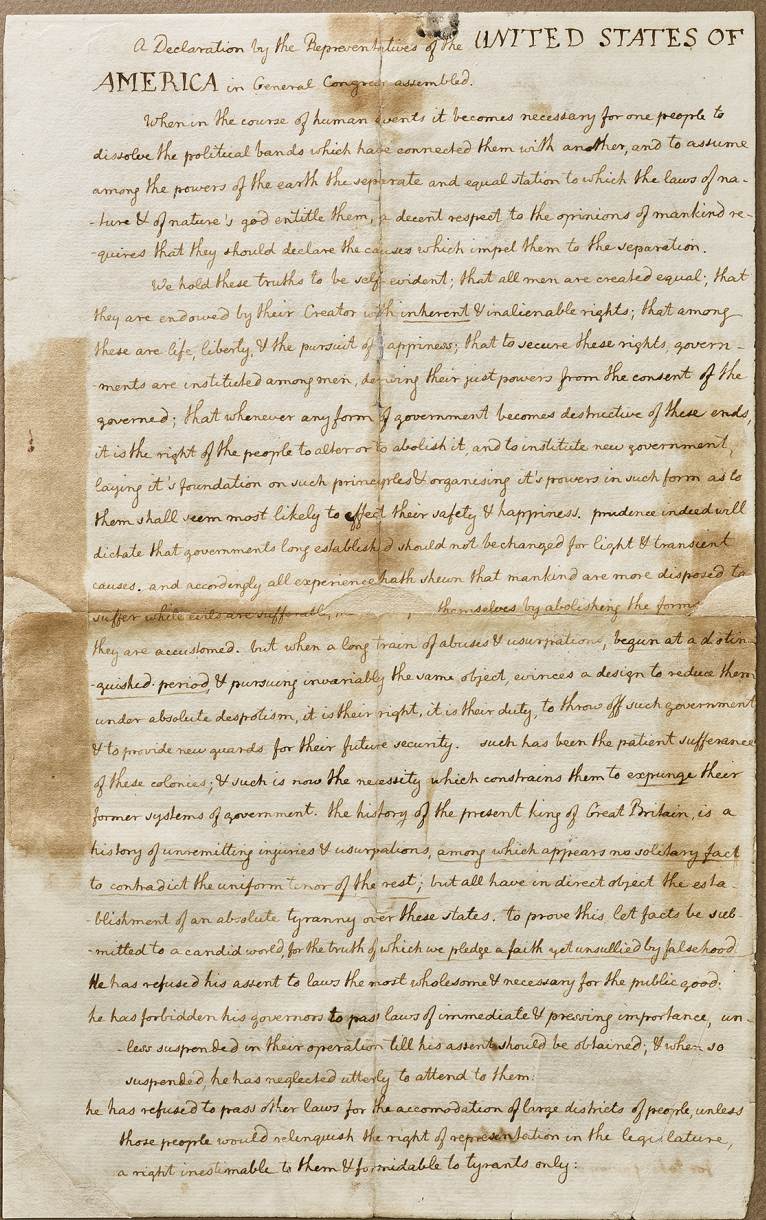
Public domain photograph of a handwritten copy of the Declaration of Independence. From Manuscripts and Archives Division, The New York Public Library
And the Declaration draft itself? We will have to imagine it sitting, with other documents, on the table in what is now Independence Hall, awaiting its own turn in the spotlight, beyond the control of the committee (and the drafter) who submitted it. What was it like? What were its words?
While Jefferson’s “original Rough draught” can give us an idea, I’d suggest instead that readers take a look at clean handwritten copy that Jefferson made and sent to his mentor George Wythe after the Declaration had been printed and published, on Monday, July 8, or shortly after.
Jefferson wanted Wythe (and others as well) to see the draft of the Declaration that was submitted to Congress on June 28. That copy is held by the New York Public Library; with a few adjustments for Jefferson’s handwriting style, it is fairly clear and readable.
Countdown to Semiquincentennial: Number 24, June 30, 1776
By Michael G. Ditmore
The photograph of the handwritten draft you posted is intriguing. I’m struck by the fact that the expression “inherent & inalienable rights” was later replaced with “certain unalienable rights.” Swapping out “inherent” for “certain” shifts attention from the nature of our rights (they’re intrinsic, not relative) to our knowledge of those rights (they’re indisputable, not obscure). More evidence, I suppose, that the framers had moved beyond speculation to conviction. I’m also struck by the fact that someone thought it would be helpful to replace “inalienable” with “unalienable.”
The inalienable/unalienable matter has bugged lots of readers, but John R. Vile (a handy Declaration expert) thinks the difference is inconsequential “because the words are synonyms” (drawing on John Smith, “Philosophical Ideas behind the Declaration of Independence).
But, yes, the “inherent” to “certain” swap is interesting, and I agree: from “intrinsic” to “knowledge” makes sense. Is it worth considering too that the first plank of the Virginia Declaration of Rights phrased the matter as “certain inherent rights”? It can feel at times that there’s a bit of word salad going on, from document to document and draft to draft (and draft again). I do wish we could know more about any discussions around the word shifts, though. For the most part, they didn’t seem to be especially heated about the changes in this paragraph — the one that WE tend to obsess about. But just how fastidious was Jefferson was striving to be in forming an “expression of the American mind”?
I just asked Gemini about the “unalienable”/”inalienable” thing, and it said (referencing The Washington Post) that “Some historians suggest John Adams (who helped oversee the printing of the text) favored ‘unalienable’ and made the alteration during the typesetting process.” I find that idea amusing, since it hints at a (“certain inherent”) personality quirk of Adams⎯he just couldn’t resist “correcting” Jefferson.
Your point about the Virginia Declaration of Rights containing “certain inherent rights” is really interesting. (This is the first I’ve heard of it.) Maybe, for the sake of precision, what Jefferson really wanted to say (all along) was something like “certain inherent inalienable rights,” but no one (including Jefferson himself) was willing to endorse such a clunky turn of phrase, so they kept trying to whittle it down in a way that best preserved the essential meaning of what they were trying to convey. ⎯Or maybe I’m just reading way too much into it. This is an obsession, after all.