
 Yesterday we celebrated the Semiquincentennial of the official adoption of the official language of the Declaration of Independence, as edited by the Continental Congress. But now that the official holiday has passed, let’s spend a little time considering what the Declaration might have said.
I’ve often thought that it might have been better if we didn’t know what differences there were between the reported Declaration draft of June 28 and the final adopted Declaration of July 4. Seems like it would have been prudent for Jefferson and everyone else to have shredded and burned all drafts and unofficial versions to prevent any confusion or tension.
But Thomas Jefferson clearly thought differently because he almost immediately sought to preserve and disperse his draft copies in at least three different ways.
- He maintained a copy of what he called the “original Rough draught,” which contains both pre-reported text, reported text, and most (but not quite all) edited text.
- After the Declaration was printed on July 4-5, 1776, Jefferson hand copied and mailed his draft to several trusted correspondents, including Richard Henry Lee, George Wythe, Edmund Pendleton, Philip Mazzei, and John Page, according to Julian Boyd, in The Declaration of Independence (pp. 43-44). Jefferson thereby ensured that if his own efforts at preservation failed, there would be multiple copies of his drafts in circulation.
- Sometime before 1783 Jefferson prepared a 20-page manuscript of the proceedings of Congress, in his own words, for June-July 1776, including the reported draft again.
While it is possible for us to compare Jefferson’s drafts of the Declaration against the final form of the John Dunlap broadside to sort out the editing, Jefferson also decided at some point do the work for us and point out the changes himself in later forms of his correspondence.
The best preserved and digitized Jefferson correspondence draft was once owned by George Wythe and now held by the New York Public Library. His marked-up copy is also embedded in his 20-page “Notes of Proceedings in the Continental Congress,” produced before 1783.
But I’ve found it easier to visualize the process from more of a 30,000-foot perspective, by using the first printing of Jefferson’s writings by his grandson Thomas Jefferson Randolph in 1829. Randolph’s method was to put additions to his grandfather’s draft in the margins and to mark deletions as underscored or italicized. I’ve taken that version and highlighted additions in blue and deletions in green in this photo.
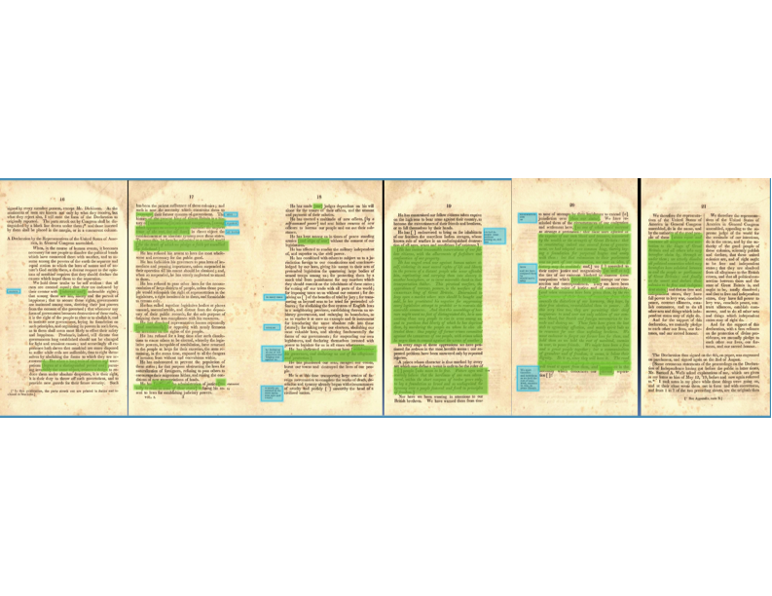
Jefferson marked additions and deletions Congress made to his draft of the Declaration of Independence. Here, I’ve highlighted additions in blue and deletions in green to provide a quick visual of how much (or how little) text was added and removed.
With the highlighted blocks, we can see that, on the whole, the additions/substitutions were really quite minimal. No changes at all to the first paragraph. In the second paragraph, “inherent and,” “begun at a distinguished period and,” and “unremitting” were struck, and “alter” replaced “expunge.”
The two longest deletions here: “among which appears no solitary fact to contradict the uniform tenor of the rest but have” and “for the truth of which we pledge a faith yet unsullied by falsehood.” Nothing that would change the course of American history in those changes; mainly just good sensible pruning of wordiness.
However, Congress’s editing became more severe as the process proceeded, which strikes me as odd. My experience has been that editors tend to be harsher earlier in a draft, but then more flexible as deadline looms and as attention flags. But exactly the opposite happened with the Declaration: The editing became both more extensive and complicated in the later sections. And ironically, most of the editing happens in the grievance section, which is the part we are most likely to skip over 250 years later.
Notably, Congress completely removed the very long and extensively revised slavery clause that Jefferson had included as the culminating grievance. Jefferson had adapted the grievances from his draft for the Virginia Constitution, but the Continental Congress did not think it was worth salvaging even a sliver or two of the slavery complaint.
Another chunk removed from Jefferson’s draft was the paragraph attacking the “British brethren” who had been deaf to the colonists’ pleas and petitions. Here, Congress gutted the paragraph by about two-thirds, mainly just be deleting two long sections. But to be selective at that point must have required some time and thought toward the very end of the editing process when patience must have been waning.
Jefferson in the “Notes” had a ready explanation for each change made by Congress. The removal of the clause “reprobating the enslaving the inhabitants of Africa” was pinned on “South Carolina & Georgia,” who had never imposed tariffs on slave importation, and also on “our Northern brethren” who, although not slaveholders themselves, “had been pretty considerable carries of them to others.”
As for the removal of the appeal to the “British brethren,” that deletion could be explained by “the pusillanimous idea that we had friends in England worth keeping terms with,” Jefferson claimed.
There you see Jefferson, the piqued Declaration drafter, in all his glory.
Yet Jefferson in his “Notes” does not mention the most complicated and momentous editing of all, which was made at the very end of the document.
First, Congress inserted two instances of “God language”: “appealing to the supreme judge of the world for the rectitude of our intentions” and then “with a firm reliance on the protection of divine providence.”
Make of that what you will.
The second change is, I think, equally momentous. In the reported draft, Jefferson closed by paraphrasing, ably enough, the basic points of the resolution for independence. But the adopted Declaration removes that material and inserts verbatim the resolution for independence made by Lee on June 7 and specifically approved on July 2.
I think both revisions provide a different tenor to the conclusion of the Declaration, both in terms of its religious observance and in its exactness in recording the wording that was actually voted on.
Moreover, insofar as independence is concerned, it is THIS section – not the principles and not the grievances – that formally establishes and announces the separation and independence, in clear and unmistakable terms. THIS – the conclusion – is THE basis for Independence Day and why we still celebrate every July 4—and every day after!
Living in the Semiquincentennial: Number 1, July 5
By Michael G. Ditmore
0 Comments