
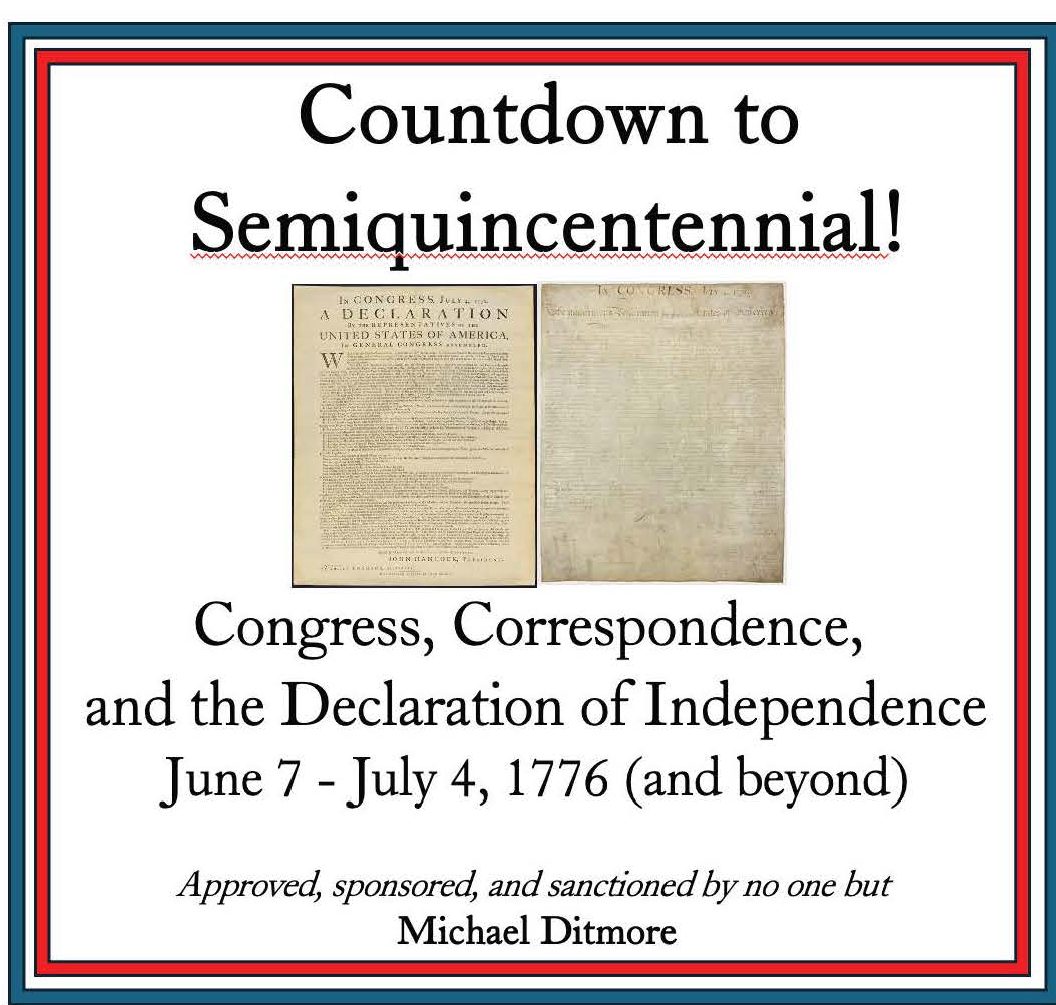
 Finally – the Fourth of July! Well, the delegates of the Second Continental Congress knew the date, but they had no way of knowing how we would see it 250 years later! Although they appreciated the gravity of the moment, Congress also had other business to attend to, as British General Howe had taken Staten Island on July 2, and Pennsylvania and New Jersey were under attack.
Still, Congress wanted the Declaration to be just right, so they continued with their group editing project even though they had approved the resolution for independence a couple of days earlier. All in all, it appears that Congress spent as much time in editing the final document as it did in approving the Lee resolution for independence.
I mentioned yesterday that we really don’t have a good idea of how the editing proceeded, but that I thought the Sherman Edwards/Peter Stone musical 1776 probably got it close, in that secretary Charles Thomson would have read aloud a sentence or a section, and everyone would have had the opportunity to chime in. Then edits would be approved by unanimous consent – although some may not have been unanimous.
In reality, it seems likely that the vote on the Declaration was taken before midday. Although Jefferson later claimed matters dragged on until evening, Paul H. Smith in Letters of Delegates to Congress convincingly argues that “the vote on the Declaration was probably taken sometime before 11:00 A.M.”
Thomson gives us no real indication of time or any details about the vote, sticking to his understated style and boilerplate wording: “Mr. Harrison reported that the committee have agreed to a declaration which they desired him to report./The declaration being read, was agreed to…”.
Around 200 broadsides of the adopted Declaration were then produced by Philadelphia printer John Dunlap’s workshop over the night of July 4-5. The National Archives has a very nicely digitized copy.
Congress directed that copies of the Dunlap broadside edition of the Declaration be dispatched to state legislatures or governing bodies and “to the several commanding officers of the continental troops” so that it could publicly proclaimed (or read aloud) “in each of the United States, and at the head of the army.”
Thomson also used a copy of the Dunlap broadside in his rough journal about what happened in Congress on July 4. For the version of notes intended for publication, Thomson handwrote the entire adopted Declaration text — thereby giving it a status of one of the official Declaration versions.
The transcript journal notes: “The foregoing declaration was by order of Congress engrossed and signed by the following members,” which is followed by the first public listing of the names of the signers. They are arranged by state, beginning with New Hampshire’s Josiah Bartlett and proceeding to Georgia’s George Walton (but not including Delaware’s Thomas M’Kean, even though his signature DOES appear on the actual engrossed parchment – yet another Declaration mystery).
Thomson doesn’t explain in either journal here how the engrossing took place, or when, or exactly when the signing happened. Congress directed that it be engrossed on parchment on July 19—not long after New York formally agreed to independence and the Declaration, and there was an initial signing on August 2 of the engrossed parchment, which was produced by Timothy Matlack.
I’ll add a few more posts to detail some of the edits Congress made to the Declaration and how we know about those edits. But today, you should just take a little time to read the Declaration of Independence in its Congress-approved July the Fourth form! According to my calculations, you should be able to do this in 10 minutes or less, depending on how fast you read. It can be tricky reading though! Eighteenth-century writers expected much greater attention spans than we seem to possess 250 years later!
Which official Declaration should you read? There are several, as you can see in a couple of New York Times articles just from this past week: David E. Sanger’s “Once the Centerpiece of Celebration, a Faded Declaration Recedes” and Isabella Kwai’s “Rare Copy of the Declaration of Independence Is Discovered in London.”
Sanger’s article details the deterioration and attempts at preservation of what many people regard as the one and only Declaration of Independence, which is on heavily guarded display at the National Archives in Washington, DC. Sanger claims this unique, signed copy of the Declaration has gotten short shrift during the Semiquincentennial – even as recently as this past Monday afternoon, “there was no wait to get into the rotunda of the Archives to peer through the glass” at the engrossed parchment, he said. As for the reading it? That’s virtually impossible, due to the deterioration, even if you know what you’re looking for. Sanger points out that if you come across a readable engrossed parchment, it is actually traceable to an engraving made in 1823 by William Stone.
Kwai reports on the May discovery of a rare Exeter, New Hampshire, broadside copy of the Declaration found by a volunteer in the British National Archives among papers from an eighteenth-century British naval captain to the Admiralty. Apparently, the captain tucked away it after finding it aboard a captured American privateer in December 1776 and passed it along —and it had remained tucked away for almost 250 years.
Well, which is THE Declaration? The answer is something like “both” and “somewhere in between.”
But as far as I am concerned, THE Declaration is Dunlap broadside (see above), produced overnight July 4-5 and then used as the template to be reprinted far and wide (such as Exeter, New Hampshire), throughout the states and overseas as well. Unlike the engrossed parchment, it contains only two names, that of President John Hancock and Secretary Charles Thomson. It is also in the format of the draft that Jefferson had submitted, and is easier to read.
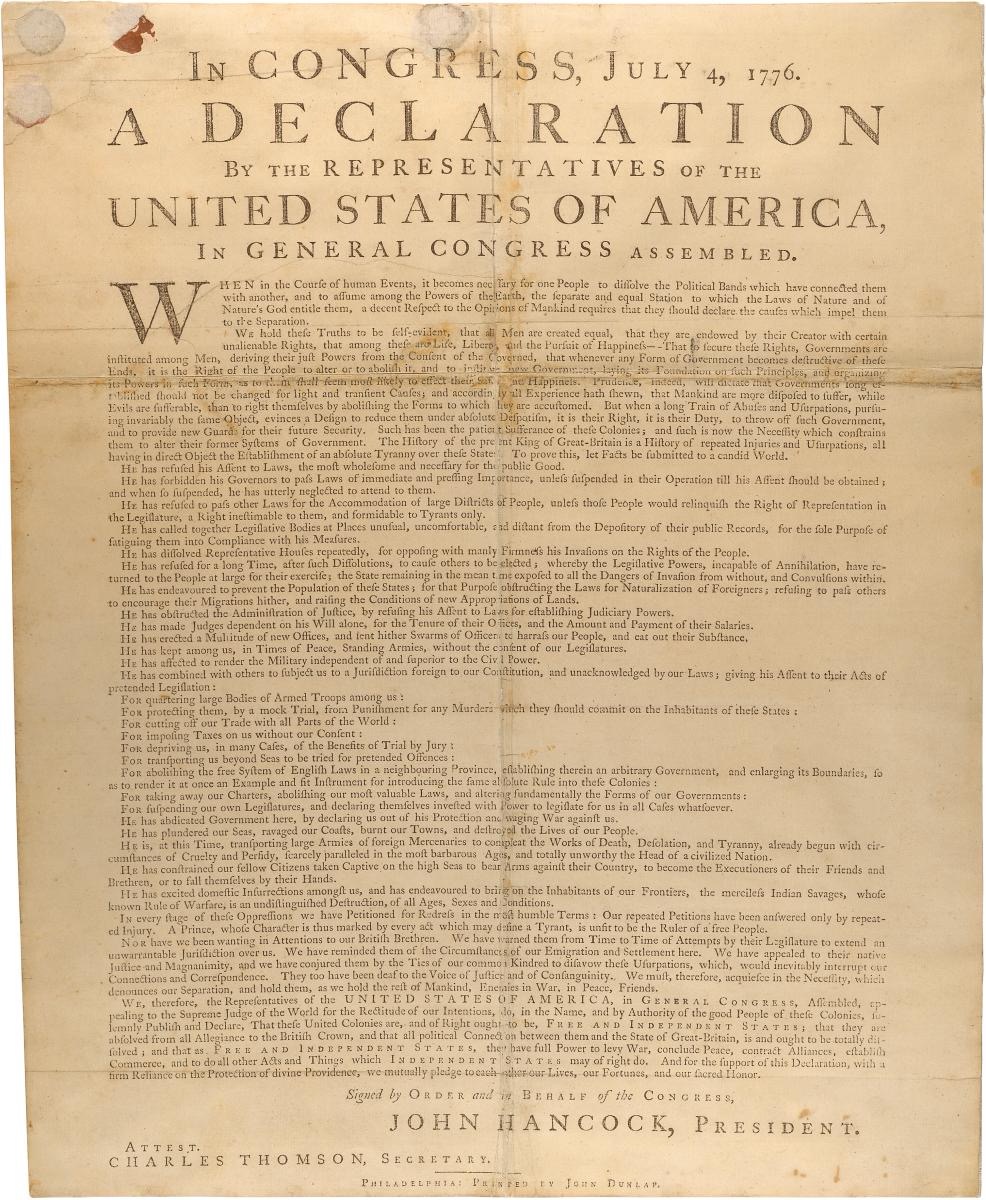
The Dunlap Broadside copy of the Declaration of Independence was created on July 4, 1776, and sent around to the states and the troops to publicize the decision of the Continental Congress regarding independence.
But as far as your reading assignment for today’s holiday–the first version of the Declaration of Independence you can pull up on the internet is acceptable. Because ultimately, its democratic, unlimited distribution is a very, very great part of what makes the Declaration of inestimable value. The Declaration that provides the foundation of our country is not confined to one particular hard-to-get-to/hard-to-read copy, but it is freely dispersed for all people to read and hear.
So today, don’t forget, in the words of John Adams, “the great anniversary Festival … solemn Acts of Devotion to God Almighty,” “Pomp and Parade, with Shews, Games, Sports, Guns, Bells, Bonfires and Illuminations from one End of this Continent to the other”!!!
Happy 250th, y’all!!!!
Countdown to Semiquincentennial: Number 28, July 4, 1776
By Michael G. Ditmore
0 Comments