
 Two North Carolina delegates, Joseph Hewes and John Penn, wrote correspondence on Friday, June 28, 1776. Hewes wrote a long news update to James Iredell (about the Canada calamity, a “damnable Plot” in New York against General Washington, privateers, the imprisoning of Scottish soldiers, Governor Franklin’s own imprisonment in Connecticut). Then he wrote:
On Monday the great question of Independancy and Total Separation from all political intercourse with Great Britain will come on, it will be carried I expect by a great Majority and then I suppose we shall take upon us a New Name.
Two letters by Penn relayed much the same information – and the same sentiment about the upcoming debate. But neither mentioned anything of the Declaration.
For the week of June 21-28, only one letter by Jefferson survives, to Benjamin Franklin possibly on the 21st and possibly referring to a Declaration draft. Adams was relatively prolific, with nine letters, one an official dispatch from the Board of War, which he chaired. None address the Declaration drafting specifically, although some touch on independence.
It is important to note that patriots did not always distinguish carefully between “independence” as such and a “declaration of independence,” even though these can refer to separate matters. The upcoming debate on independence would not, so far as we call tell, touch on the Declaration that followed.
Congress’s business continued much along the same track, with letters, petitions, claims. One important matter involved the appointment of new and continuing delegates from New Jersey along with new instructions to “empower [them] to join” with other delegations in “declaring the United Colonies independent of Great Britain.” Now that Governor William Franklin was jailed and the former legislature defunct, New Jersey was fully on board.
Congress approved Monsieur Le chevalier de Kirmovan as an engineer; New Jersey’s Francis Hopkinson was added to the plan of confederation committee; the Secret Committee was directed to sell 300 pounds of gunpowder to Salem county, New Jersey.
Shortly afterward, if we follow the journal’s order, a most significant matter occurred, although, again, secretary Charles Thomson’s efficient manner of recording hardly seems to note anything of its significance, inserted as it was in just over midway of that day’s record:
The committee appointed to prepare a declaration &c. brought in a draught, which was read:
Ordered to lie on the table.
Really? That’s all?
So, the committee – presumably with Jefferson in the forefront – presented the draft to Thomson (with President Hancock’s approval) who then, we would have to think, read it aloud to the room (unless there was an unknown appointed reader) – and then placed it physically on a table for delegate inspection, but not to be removed.
What were the contents of that draft? What happened to it? We can’t say with “beyond a reasonable doubt” certainty, but one would expect the punctilious Thomson to have kept a close eye on it. Most likely Jefferson submitted a clean fair copy in his own handwriting, which Thomson later had at hand when Congress began to make its edits on July 3-4.
Thomson either would have marked that copy as Congress went through, or he would have begun a second copy of only the final text – we really, really just don’t know precisely how this was managed, except that there is no known surviving copy of exactly what Jefferson submitted, what Thomson worked with, or what was sent to John Dunlap, the printer.
We can make strong approximate guesses of various kinds. Some editors have used the Adams fair copy or have used a clean copy of the “original Rough draught.” Another option is to consider one of the draft copies Jefferson sent out to selected correspondents starting on July 8 – but that would us get ahead of ourselves for the moment.
Instead, let’s turn to THE most iconic visualization of the Declaration of Independence, the one virtually all Americans would imagine if asked, that painted by Connecticut artist John Trumbull in 1817-19 and installed in the Capitol Rotunda in 1826.
Here is my own smartphone photo, taken July 20, 2018, at 3:05pm (just so everyone knows).
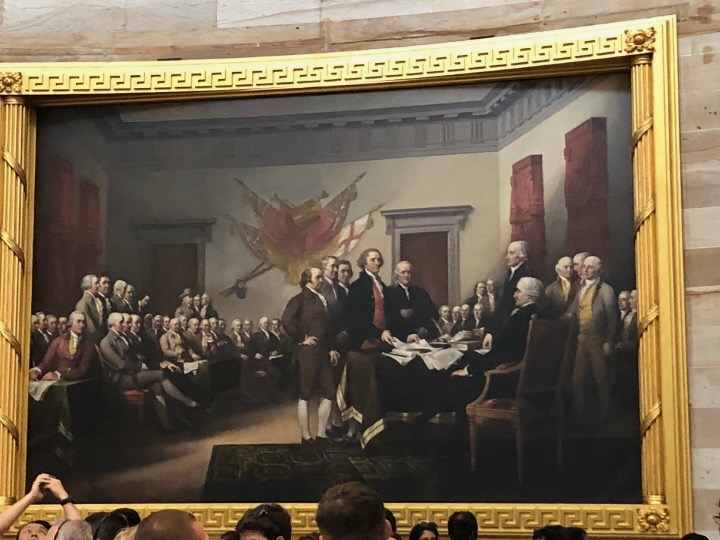
Of course, you can find a clearer, more helpful version on Wikimedia Commons, but I chose my own photo because it’s closer to what visitors will actually experience in seeing it: the tops of lots and lots of visitors’ heads. (But it doesn’t reproduce all the voices and foot shuffling.)
Trumbull’s painting – which he had begun to develop with Thomas Jefferson’s assistance in Paris in 1786 – is one of a quartet of his paintings in the Rotunda. The others depict Burgoyne’s surrender, Cornwallis’s surrender, and yet another highly celebrated surrender: that of General Washington and his military commission to Congress in Annapolis, Maryland.
Trumbull spent years working on the painting to make the individual portraits as true-to-life as possible; he visited the subjects and took portrait sketches, or used existing portraits, or sometimes resorted to family members said to bear a resemblance. He finally decided to move forward in a big way with the Declaration portrait in the wake of the War of 1812 when the Capitol needed repair and remodeling following the British destruction of it and other buildings (including the White House) in August 1814.
Trumbull, and especially this painting, has occasioned a considerable amount of commentary. The most recent biography of Trumbull is by Richard Brookhiser.
The painting had its fans and detractors – and even mockers – from the outset. Trumbull staged ticketed exhibitions in several cities before installation in the Capitol, and he also had prepared engraved copies for sale – after all, he was a working American artist. Some people disliked the overall composition scheme, others disputed the presence or absence of delegates.
If we were to approach it in terms of Declaration signers: most are present somewhere or other in the painting, but some who signed are not present, and some didn’t sign are. The layout of the room is also wrong — there would have been only one door at the back; Trumbull corrected this in a later, smaller version.
But the subject of the painting is NOT the signing, whenever that occurred. Actually, the subject of the painting is the submission of the final Declaration draft on Friday, June 28, 1776 – that is what is in Jefferson’s hand as he is about to lay it on Hancock’s desk, with Thomson at the side. At this point, Congress has not even formally resumed its debate on independence, and certainly Trumbull makes the occasion far more momentous than Thomson does in the journals.
And almost certainly the staging of the drafting committee was suggested to Trumbull by Jefferson himself, with Jefferson very much in the lead, Adams (who, as we’ll see, advocated for the Declaration) close to his right elbow, Franklin slightly behind on his left, Roger Sherman a bit behind all three, and Robert R. Livingston (who may have done nothing more than attend the first committee meeting) squeezed in at the very back.
It’s certainly a painting worth staring at a good while, even if you can’t identify all the faces – and despite its mistakes. Trumbull aimed at something perhaps more iconic and mythological: the world-changing power of verbal documents drawn by rational people on behalf of their rights and principles. Along with Washington’s surrendering of his commission (an equally world-changing event, and a lesson we could learn from), the painting of the Declaration drafting committee forms a counterpoint to the two battlefield paintings.
One last tidbit. As Trumbull went through the preparations with the painting, exhibitions, and engravings in in 1817 and later, he corresponded with both Jefferson and Adams, seeking their support (and subscriptions). Jefferson was pliable enough, but Adams was a bit cranky (he thought James Otis’s public disputing of writs of assistance in 1761 would have been a proper subject for an historical painting).
When the painting came to Boston in the autumn of 1818, Adams was at first resistant to make the trip from his home in Quincy. He was not only becoming more decrepit but was mourning the death of his beloved Abigail on October 28. But he finally agreed, if he could be accompanied by his cousin Mrs. Josiah Quincy; accordingly, Adams made the trip on December 5.
When they arrived at Faneuil Hall, the artist himself met them at the carriage and attempted to usher them out of the carriage but was pushed away by Adams who insisted on escorting Mrs. Quincy by himself. According to daughter Eliza Susan Quincy, “It was very interesting to view this picture with one of the last survivors of the signers of the Declaration of Independence” – and indeed, it must have been, 42 years after the fact.
In Eliza’s account, Adams noted only: “When I nominated George Washington of Virginia for Commander in Chief of the Continental Army, he took his hat and rushed out that door.”
Adams himself, however, was more, shall we say, restrained. In letters to both John Quincy Adams and Thomas Jefferson later that same week, he noted visiting the painting but complained of catching a cold because he’d removed his hat.
Jefferson himself never saw the painting in person, but must have seen engraved reproductions.
For a moment, though, let’s not allow Adams’s temperament to get in the way of our imagining him in cold, drafty Faneuil Hall, poring over the faces and complex memories – with himself, if slightly behind Jefferson, nonetheless front and center in the depiction of one of the most composed and quietest and yet most momentous moments in world history.
Countdown to Semiquincentennial: Number 22, June 28, 1776
By Michael G. Ditmore
0 Comments