
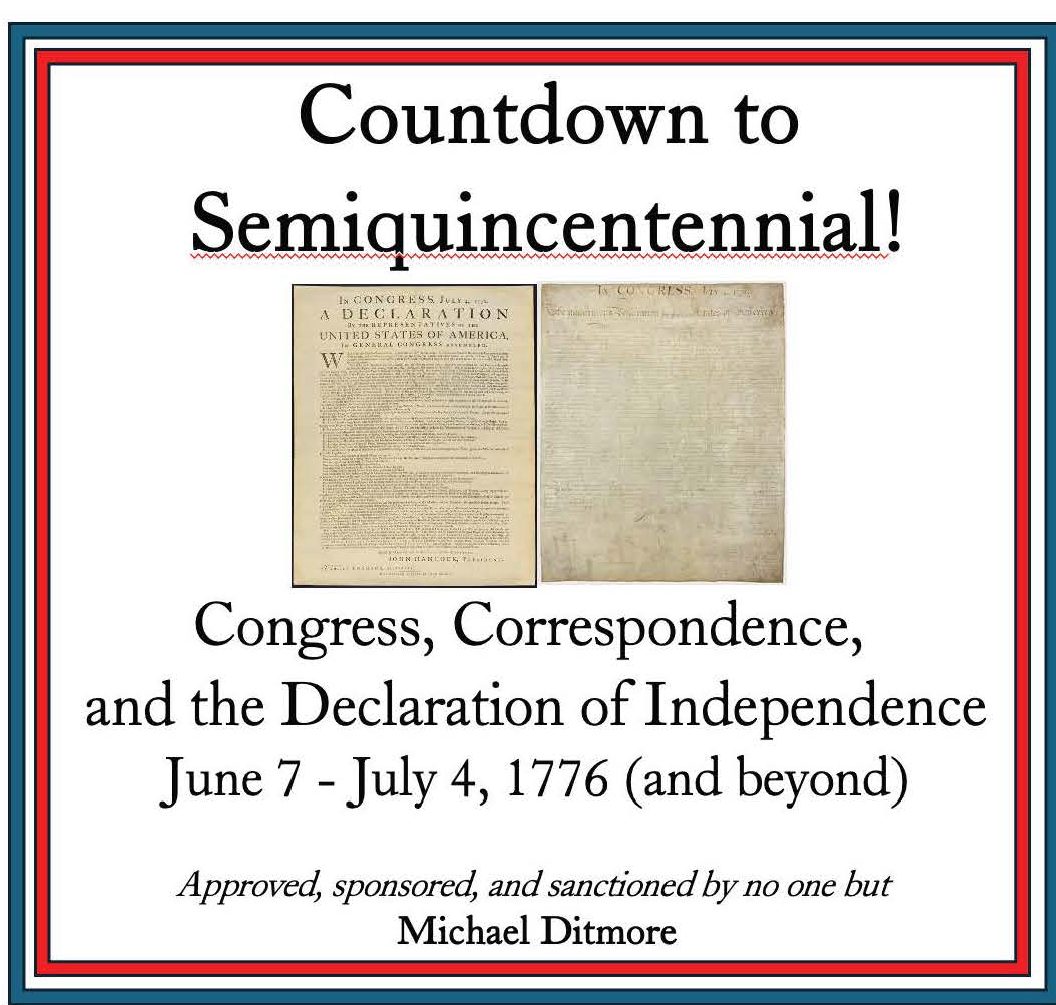
 Focusing attention solely on Congress’s journals, of course, can result in sanitized tunnel vision – yet reading them in order also affords us an opportunity to consider events as they unfolded in something like real time, and perhaps even give some idea of what Jefferson what might have been processing while drafting the Declaration.
Friday, June 14, 1776, was another business-packed day with multiple letters to be considered (and others to be dispatched), much continuing business (like the investigation of gunpowder manufacture at O. Eve’s mill), etc. The New York Convention had expressed concerns for dealing with “disaffected and dangerous persons” there, who might be identified, disarmed, and even punished for “having any intercourse or correspondence with the enemy” (yes, the British), which should remind us that not everyone was a patriot on this side of the Atlantic.
On this day, Charles Thomson, after having had a committee to handle the matter, was compensated to “the sum of one thousand two hundred dollars … in consideration of his faithful services for one year.” It must have been interesting for Thomson to have recorded his own name in such a way (although the printer Aitken misspelled his last name as Thompson).
There was more concern for the Iroquois; the committee on spies was “directed to revise the rules and articles of war,” and a “petition from Mrs. ***, was presented to Congress and read.”
A long “memorial” from the Pennsylvania committee of safety sought continental funding for a redoubt on the Delaware River, after consultation with an engineer about the potential passage of enemy ships. A blacksmith proposed supplying camp kettles – of such small details are wars fought – and soTimothy Matlack was directed to write an order to Thomas Mayberry of Mountholly for “five tons of sheet iron” for the blacksmith.
Matlack’s name shows up rarely in the journals, but it is worthy pausing on his name because he will later be the calligrapher for the engraved parchment of the Declaration now on display at the National Archives.
And as for Jefferson and drafting the Declaration?
Yesterday I noted that a significant portion of the Declaration – the grievances against George III – had already been written as the preamble to his draft of the Virginia Constitution. Jefferson would not know until the end of July what had happened, in a vaguely worded letter from George Wythe:
An attempt to alter it as to you was made in vain. When I came here the plan of government had been committed to the whole house. To those who had the chief hand in forming it the one you put into my hands was shewn. Two or three parts of this were, with little alteration, inserted in that: but such was the impatience of sitting long enough to discuss several important points in which they differ, and so many other matters were necessarily to be dispatched before the adjournment that I was persuaded the revision of a subject the members seemed tired of would at that time have been unsuccessfully proposed. The system agreed to in my opinion requires reformation.
Even then, Wythe’s account doesn’t point toward the preamble’s inclusion.
But there is another, not well known starting place for the Declaration’s drafting to consider, one that was discovered only in 1947 by Julian P. Boyd, a librarian-scholar who was to become the editor-in-chief of The Papers of Thomas Jefferson for the Princeton University Press (begun in 1950, the volumes are still in process of completion). Boyd had already overseen a major exhibition of Declaration-related documents at the Library of Congress in 1943, the bicentennial of Jefferson’s birth, accompanied by an oversized volume that included photofacsimile images of documents that had never been seen publicly before. Originally published in 1943, by the Library of Congress, and then in a downsized version in 1945 by Princeton University Press, it was abridged and updated in color with additional editing by Gerard G. Gawalt in 1999 by the Library of Congress.
Boyd also happened to be a major Jefferson fanboy. In 1947, while working with the Library of Congress collection of Jefferson materials, Boyd discovered a small manuscript fragment of the Declaration that had been overlooked – and little wonder. As he later described it, it “appears on one of three half-leaves” that also included a draft and fair copy of a resolution concerning General Sullivan, part of a rough draft of another report, and a sketch/description of a horse stall – as Boyd described it, “the earliest known text of the Declaration of Independence.”
See Boyd’s transcription here.
It’s as helpful to see a grayscale digitization of the same at the Library of Congress.
And finally, Boyd recounted the fragment and much, much more in an excellent article in the New York Times, April 13, 1947, (pp. 17. 64-65, 67-70), “New Light on Jefferson and His Great Task.”
Countdown to Semiquincentennial: Number 8, June 14
By Michael G. Ditmore
0 Comments