
 Thursday, June 13, 1776, was a crowded but not especially dramatic day in the Second Continental Congress.
In the previous post, we established that Jefferson had been appointed – either by Adams or by the committee – to draft the Declaration. When and how did he actually begin putting words to paper? It would be nice to think that he began with “When in the course of human events …” and just went from there.
But actually, Jefferson had already drafted the most extensive section of the Declaration, the catalog of accusations (or bill of indictments) against George III, but for another document entirely. He just was going to going to edit and adapt it from the one document to the other (what we might call a cut-and-paste job).
On May 15, the day after Jefferson arrived Philadelphia, the Fifth Virginia Convention back in Williamsburg passed two resolutions reflecting Virginia’s own separation from England. The first instructed their delegates in Congress to propose independence for the United Colonies – this would lead directly to the Lee resolution for independence on June 7.
The second went on to establish a committee that would first prepare a declaration of rights and then a plan of government. This document was swiftly published in Alexander Purdie’s Virginia Gazette on May 17 and then reprinted in newspapers in the other colonies/state, including the Philadelphia Evening Post on May 28.
The “plan of government” especially caught Jefferson’s eye. He desperately wanted to be back in Williamsburg on the ground floor of establishing a new government, and so he soon began drafting his own Virginia Constitution, in either late May or early June. His drafting went through three versions before he handed off a final version to George Wythe, who was returning to Williamsburg with Richard Henry Lee around June 12.
Unfortunately, by the time Jefferson’s draft came to the attention of the Virginia constitution committee (led by George Mason), it had already completed an extensive draft of its own and saw no way to accommodate much of Jefferson’s version – with a single exception.
From the beginning of the first draft, Jefferson had written a preamble to explain the rationale for a constitution, which was a catalog of 23 accusations against “George Guelph King of Great Britain & Elector of Hanover, heretofore entrusted with the exercise of the kingly office in this government, [who] whath endeavored to pervert the same into a detestable & insupportable tyranny.”
The Virginia committee decided to add all of this preamble to the constitution, where it remained part of the Virginia Constitution, through various revisions and overhauls, until 1903 when it was finally removed as no longer relevant.
But later in June when Jefferson was drafting the Declaration of Independence, he slightly revised and reordered this catalog for the long middle section of the Declaration – the accusations against George III.
We can get a sense of this textual repurposing by just considering the very first one. Jefferson’s first draft for the Virginia Constitution: “by putting his negative on laws the most wholesome & necessary for the public good”
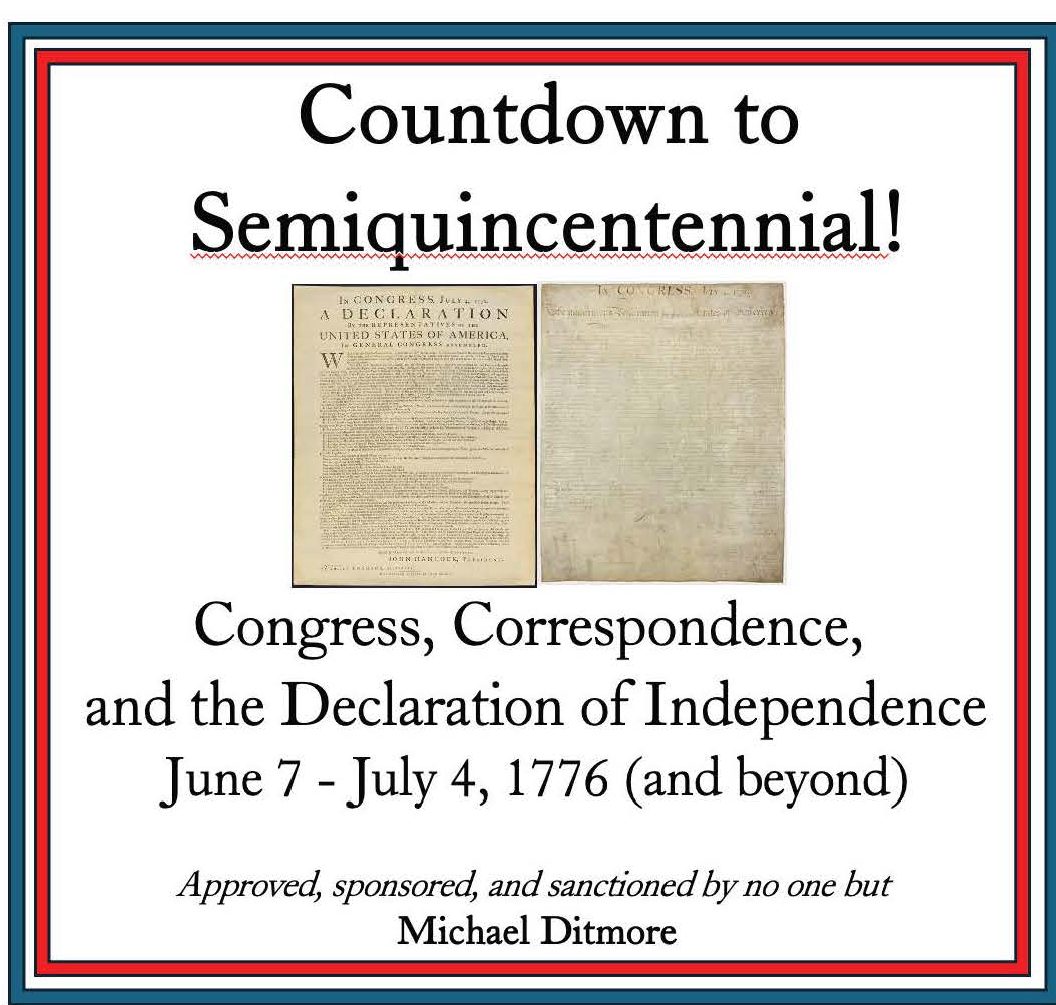
The Dunlap broadside of the Declaration of Independence: “HE has refused his Assent to Laws, the most wholesome and necessary for the public Good.”
There’s just not a lot of verbal difference between the two, is there? That isn’t to say that this is exactly where Jefferson “began” when drafting the Declaration proper. Maybe it’s just to say that pinpointing a precise “beginning” is more complicated than we’d think. At the same time, it doesn’t appear that Jefferson informed anyone of this procedure, or that anyone (especially in Virginia) noticed – or even cared.
But before moving on, it is important to note one of the accusations against George III that did NOT survive to the final Declaration, despite Jefferson’s very extensive editing of it:
by prompting our negroes to rise in arms among us; those very negroes whom by an inhuman use of his negative he hath refused us permission to exclude by law.
It is an obnoxious accusation, one that requires some historical background even to explain its references. And in Jefferson’s editing for the Declaration, it would become both softened, amplified, and overheated. Stay tuned!
Countdown to Semiquincentennial: Number 7, June 13
By Michael G. Ditmore
0 Comments