
In terms of Declaration-specific matters, both the Congress journals and surviving delegate correspondence are not helpful.
Mainly, Congress was taken up with military matters – sorting out and repairing the damage from the Canada mess; seeking an engineer; officer appointments; correspondence with the New York convention over battalion orders; more claims and compensations; and a “bounty of ten dollars [to] be given to every non-commissioned officer and soldier who will inlist to serve for the term of three years” – a signing bonus, in effect, and an important one because the generals had already been struggling with troops ready to leave the instant their enlistments expired. And other matters.
In correspondence, John Adams found time to write to Abigail, complaining especially about Canada and also small pox, in somewhat nasty terms. He also bemoaned his workload for Congress, “more Business than I qualified for,” to the impairment of his health – especially heading up the Board of War and Ordinance: “The Board sit, every Morning and every Evening.”
And yet Adams says not a word, either about the Declaration drafting committee or the impending vote on independence.
Now would be a good time, then, to touch on what Thomas Jefferson came to call the “original Rough draught,” and which editor Julian Boyd termed “the most extraordinarly interesting document in American history.” After all, Jefferson’s draft was surely about this far along by this Wednesday, June 26, since the submission would happen on Friday – and it is quite probable that Jefferson drew the submitted fair copy from the “original Rough draught.”
Boyd may well have been correct, but the “oRd” (let’s call it for short) is also a most difficult document to deal with, especially if you can’t handle it yourself – and you can’t, because, as a Top Treasure of the Library of Congress, no one at all can handle it and it is rarely put on public exhibition. And so, we’re left mainly with more-or-less well done facsimiles, photofacsimiles, or editorial reconstructions (one by Boyd, of course).
Why? Just take a look at page one of one of the better reproductions available online from the collection of Jefferson’s papers at Princeton University.
But the Wikimedia Commons pages are also very good for closer looks (although I can’t tell how they were obtained – and be careful, because the images are out of order).
From Wikimedia Commons
There are four pages altogether, and even the very first one resembles Jefferson’s typical drafting method – neat lines of neat handwriting, with considerable strikeouts, insertions, interlineations, and brackets, plus sometimes entire additional lines squeezed in as tightly as possible. Sometimes we can make out the initial writing through the strikeouts, sometimes not. For example, we can make out “sacred & undeniable” struck out for “self-evident,” interlineated above with a caret below (and we can make out “sacred & undeniable” because of the John Adams copy).
In other words, the oRd reflects layers of composition on top of what seems to have been at one time a single complete fair copy.
To complicate matters, according to Jefferson’s marginalia, some of the changes are also in the handwriting of either John Adams or Benjamin Franklin. BUT Jefferson also held on to this copy and recorded most, but not all, of Congress’s edits. In other words, there are at a minimum five different layers: Jefferson’s original fair copy; Jefferson’s own edits; Adams; Franklin; and then Congress (but the intermediate edits could be different order; only the original fair copy and Congress’s edit are certain). So, as an artifact, it reminds us that although Jefferson may have taken the drafting lead, it also did circulate in committee (at least with Adams and Franklin here).
(To complicate matters a half-step further, toward the top of second page, Jefferson also attached or glued in a separate strip of text among the grievances – but it takes some effort to find it in the Jefferson Papers link above, while the Wikimedia Commons version simply has the attachment photographed on top of the underlying text.
Jefferson held on to and preserved this document, but the only semi-confirmed account of his sharing it came in a sketchy newspaper account in 1822 in which – we’d think – it is described as “scored and scratched like a schoolboy’s exercise.” Thus, its public or even privately shared existence occurred posthumously, after Jefferson’s death in 1826.
And so, the oRd is an absolutely priceless and invaluable record of Declaration drafting – and yet one incredibly difficult for even above-average readers to sort through except in admiration. In some ways, its main value is visual and iconic. It looks incredibly authentic and on-the-spot, and it has gone through numerous facsimile reproduction since its first appearance (I think) in 1829 in his grandson Thomas Jefferson Randolph’s first collection of Jefferson writings.
Even without trying to “read” the oRd, we can immediately say that most of the editorial fussing among the committee members came on page one, in the paragraph on principles and rights. Jefferson and they seemed concerned to get that just right. By and large, the grievances are not touched on much, except by way of additional lines. (We might note that “Scotch & other” is here interlineated before “foreign mercenaries.”) Another bit of henscratching appears in the bottom of p. 3, at the end of the “British brethren” paragraph; Jefferson (and the committee) clearly labeled over the wording here – only to have it largely removed.
Jefferson employed brackets – although they may not be easily visible – for material deleted by Congress in its edits of July 3-4. Because the brackets are not eye-catching, Congress’s deletions don’t immediately appear so evident. (We’ll later see the visual markings become more evident in Jefferson’s “Notes of Proceedings” version of the submitted draft.)
There are two matters to note, however.
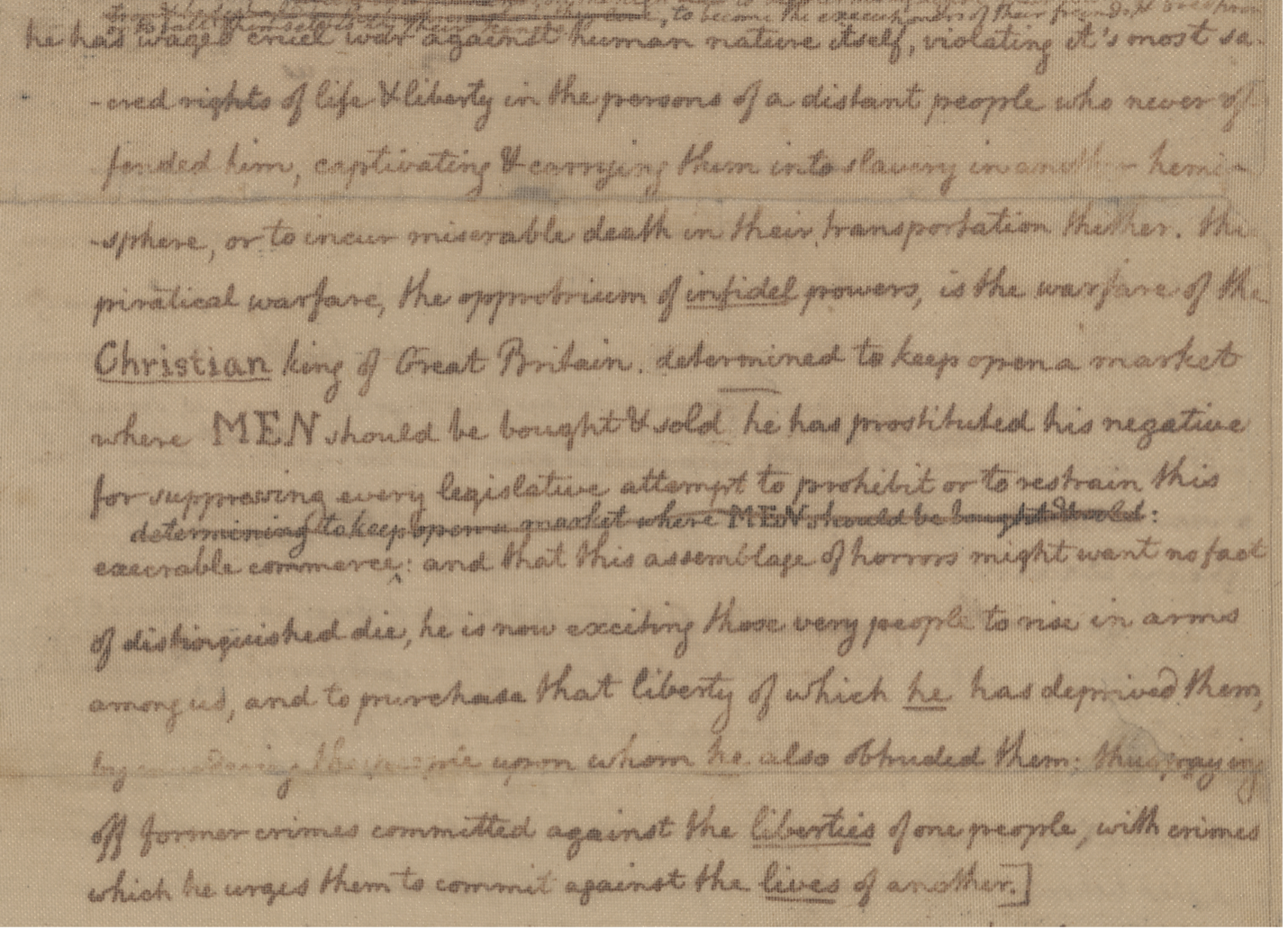
- On page 3, we find the final of the grievances, a long clause devoted to slavery – real, not metaphorical, slavery, also known as chattel slavery and of the kind legally practiced by Virginia slaveholders. I’d like to spend more time on this clause later, but here we can just note its visual appearance. One of Jefferson’s stylistic quirks was that he wouldn’t capitalize the first letter of a new sentence; he tended to be sparing with noun capitalization, except with proper nouns. As a result, I’d say, his handwriting tends to look both uncluttered and calm – except … in THIS case. Here, Jefferson capitalizes and underscores (for italicization) “Christian” – the only use of “Christian” in the document – and fully capitalizes “MEN.” He also underscores several other words: infidel, he, he, liberties, and lives. Jefferson was designing this passage to be not just rhetorically catching to the ear, but certainly to be visually eye catching and emphatic. And yet Congress deleted the whole of it, seemingly without bothering to salvage any of it.
- As I mentioned, Jefferson indicated on the oRd Congress’s edits, either with insertions for additions or with brackets for deletions. Although I don’t think it happened, it’s easy to imagine Jefferson sitting at his desk in Independence Hall as Congress made the edits (not so unlike as imagined in the musical 1776) and marking the changes directly on the oRd. But if so, he missed at least two, at the very end.
- The first has to do with the “God language” (my words) Congress inserted in the closing paragraph. First, between “assembled” and “do,” Congress added “appealing to the supreme judge of the world for the rectitude of our intentions” – Jefferson properly interlineated that in the oRd – then at the end, between “declaration” and “we,” “with a firm reliance on the protection of divine providence” – Jefferson omits that altogether. It is intriguing to begin with that no one on the drafting committee thought of this to begin with, and then it is doubly intriguing that Jefferson notes the first but not the second on the oRd.
- The second is both easier and more complicated. For the conclusion, Jefferson had drafted a paraphrase of the Lee resolution for independence; Congress apparently decided that the Declaration needed to include the verbatim wording of that resolution, and so the final Declaration substitutes the Lee resolution (not identified as such) in place of Jefferson’s paraphrase. Again, it is intriguing – maybe triply so – that no one on the drafting committee thought of this, either.
Jefferson does have an opening bracket for “reject” and then a closing one after “declaration” – but that’s not quite accurate. In fact, because Congress’s change in this instance, although a simple enough one, also presents difficulties in trying to visually mark it in an easy way – it would seem that Jefferson decided against trying to do that with the oRd.
And so … that’s an all-too-quick peek at Jefferson’s “original Rough draught” that bears direct and indirect marks of having gone through so many hands on its way to the final Declaration. But we still haven’t even arrived at a reported Declaration draft (that will happen on Friday) – and more importantly, we still haven’t gotten a vote for independence taken care of. Without that, there is no Declaration!
Countdown to Semiquincentennial: Number 20, June 26
By Michael G. Ditmore
0 Comments