
 After an unusually long adjournment, Congress resumed business with two letters from General Washington and a resolution “to put a stop to the raising the companies of Mohickan and Stockbridge indians.” Quoting a New Jersey convention letter describing Governor Franklin as “virulent enemy to his country,” they resolve to have Franklin confined and sent to Governor Trumbull in Connecticut. Various military materiel issues are addressed.
And then Congress appointed a committee of thirteen – one from each colony – for a formal inquiry into the Canada debacle. The committee includes Roger Sherman and Thomas Jefferson, both Declaration drafting committee members. The committee on spies – yes, there was a committee on spies – prompted a resolution on activities that would fall under the umbrella of spying for enemies (i.e., England); those doing so should be “guilty of treason”; but the resolutions turns into “recommendations” for “the several legislatures of the United Colonies.”
In correspondence, John Adams updated Samuel Chase of Maryland on multiple manners, including the Canada matter. He thought that part of “our Misfortunes” came not just from the battlefield; “[a] Declaration of Independency, Confederation, and foreign Alliances, in Season, would have put a Stop to that embarrasing opposition in Congress, which has occasioned us to do the Work of the Lord deceitfully in Canada and elsewhere.” But Maryland, New Jersey, and Pennsylvania were all coming around.
To fellow Masschusettsan William Tudor, Adams expresses chagrin at laggardness of New York politics: “Is there any Thing, in the Air, or Soil of New York unfriendly to the Spirit of Liberty?”
Josiah Bartlett (New Hampshire) wrote a lovely familiar letter to his wife Mary Bartlett, more on the domestic side of things. “I have for 2 or 3 Days past in the afternoon rode Back a mile or two & the very air of Country seems reviving.” But he too can’t bypass the “most Scandalous Business” of the Cedars matter in Canada – it involved New Hampshire troops, after all. And he informs her of his committee work on what will become the Articles of Confederation, “a matter of greatest Consequence & [requiring] the greatest Care in forming” – but, unlike Adams, says nothing about the independence matter or the Declaration.
The Declaration drafting, meanwhile, seems mainly to be going on in the background. Presumably, delegates were too busy or respectful to insert their noses into Jefferson’s work, or maybe they just assumed it was going to be mainly “just another” Congress document.
I promised yesterday, however, a recent discovery about the Declaration – and, as it happens, it bears a date of June 24!
Although the dates of discovery, sharing, and investigation are unclear (although I’m going to go with 2023 generally), Jonathan Scheick, an independent researcher (and adjunct professor and healthcare clinician) who sits on the board of the Thomas Paine Historical Association, has published online a carefully (but sometimes vaguely) detailed account of the recent uncovering of … that’s such a long sentence I’m going to pause for a moment … of an authentic manuscript copy of a Declaration draft, most likely written by Adams and shared with Roger Sherman. You can see colored photofacsimile images of the pages along with a highly detailed account of the TPHA investigation and analysis, using OpenAI/ChatGPT, here (titled “Roger Sherman’s Draft Copy of the Declaration of Independence.”
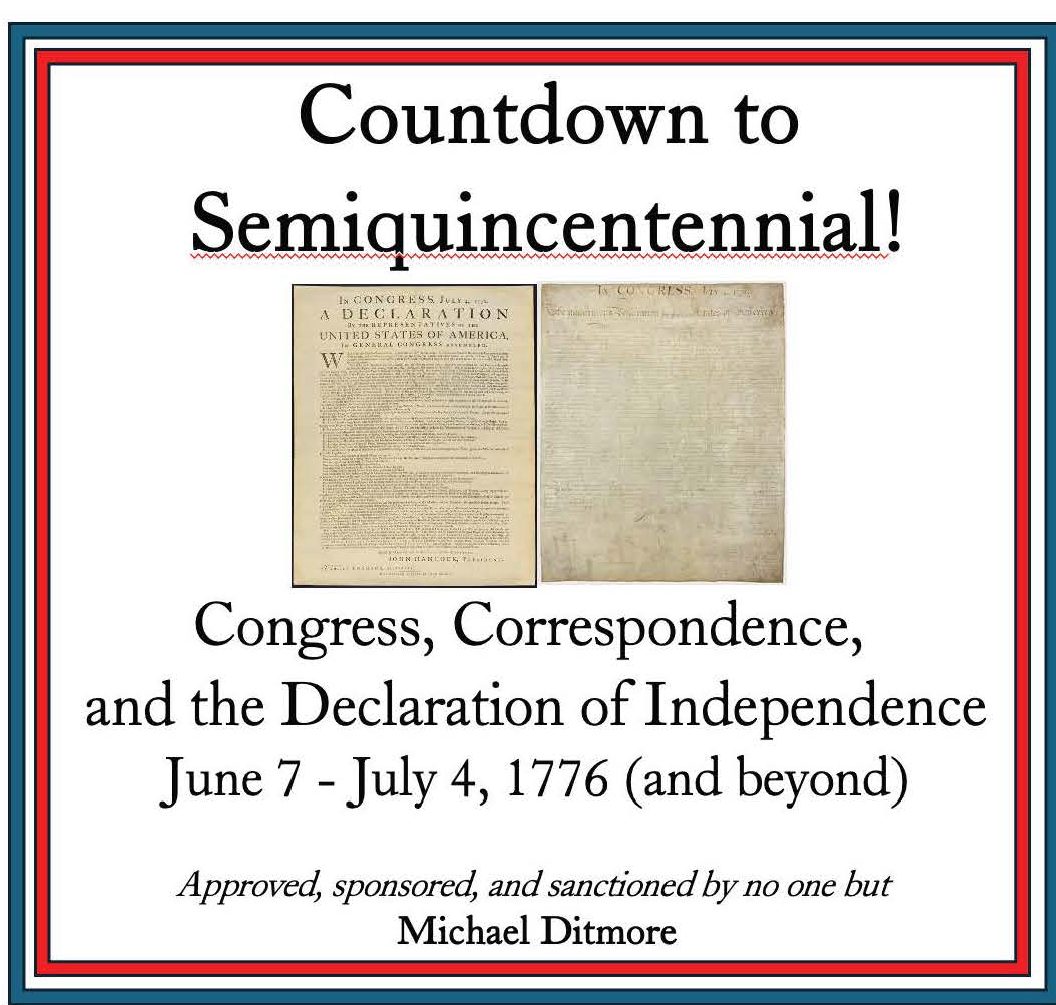
This IS an absolutely fascinating discovery! But there are caveats and qualifications in order. It contains only the first of what would have been four pages; it begins at the beginning and stops with the third of the grievances against George III; there’s no indication about what happened to the missing pages. The TPHA analysis concluded that it is most likely in Adams’s handwriting; I’ve no quibble with that finding, except that – placing the documents side by side – the full Adams copy (I discussed yesterday) is neatly and clearly arranged, whereas the TPHA copy’s left margin slopes considerably, the spacing looks much more cramped, and there was obviously some kind of inkflow problem, since the writing is periodically much darker in some areas than in others. The investigators chalk these matters up to “haste” in the copying.
The investigation went into extensive detail – terms like “disconfirmatory analysis,” “competing-hypothesis evaluation,” and “parallel exploratory assessment” show up, along with analysis of the paper (down to paper shortage at the time), handwriting style, etc. Yes – I believe that this is really an authentic Declaration draft, that it very probably was made by Adams (and aligns with the text of the Adams full copy), and that it was in the possession of Roger Sherman at some point.
And yet … Scheick shares little more about its provenance, other than to say that “an amateur historian in Georgia” discovered it “folded with an estate auction booklet for General Hugh Lowrey White, a Brigadier General in the War of 1812,” all “within a box of discarded papers.” Later, it “was brought to attention of the Thomas Paine Historical Association.” No names, OK, but the lack of dates is a little concerning – as is the lack of description of “discarded papers.” Or why the amateur historian chose not to bring the document to the attention of the Library of Congress? The Massachusetts Historical Society? The Connecticut Museum of Culture and History?
The explanation is to be found in a somewhat cryptic writing on the verso (reverse side) of the draft proper, apparently a brief note by Adams describing the contents:
“A beginning perhaps –
Original with Jefferson –
Copied from Original
with T.P.’s permission”
Below and to the right appear – maybe — to be the initials of Benjamin Franklin.
The bigger mystery is “T.P.” Scheick and TPHA are convinced that it refers to Thomas Paine. The fringe theory that Thomas Paine, and not Thomas Jefferson, authored the Declaration of Independence was, as far as I can tell, first broached in 1872 by Joel Moody in his anonymous Junius Unmasked: Or, Thomas Paine the Author of The Letters of Junius, and the Declaration of Independence. (Letters of Junius was a London 1770 collection of complaints against George III; Sheick references Moody in his bibliography).
A sample from Moody: “The style of the Declaration of Independence is in every particular the style of Mr. Paine and Junius; and it is in no particular the style of Thomas Jefferson” (p. 234).
And also, as far as I can tell, the TPHA still hews to this theory, and thus its analysis of the Sherman copy interprets “T.P.” as none other than Thomas Paine, a view not discorroborated by Declaration scholars Danielle Allen and Emily Sneff. In other words, Allen and Sneff could not propose any other Declaration-related person in the Philadelphia area in June 1776 with the initials T.P. except Paine, and so, convolutedly: “While it was acknowledged that the T.P. initials could reference another individual, the contextual understanding of individuals privy to the Declaration drafting process appeared to strongly favor Thomas Paine.”
To be candid, I find the theory to be too fringe to take seriously to explore it any depth. For one thing, Paine would also have to be credited for authoring the preamble to the Virginia Constitution – possible, I suppose, but extraordinarily unlikely to the point of next-to-impossible.
Regardless of authorship, however, the Sherman draft copy is of immense value for our understanding of the Declaration’s drafting, if only to include Sherman – often, with Livingston, the forgotten member of the committee – and to show us that a Declaration draft was distributed among committee members (not just Adams and Franklin) before its formal submission – just four days ahead!
Countdown to Semiquincentennial: Number 18, June 24
By Michael G. Ditmore
0 Comments