
 Amid so much celebration, it is at the same time appropriate to reexamine the agonizing drama that led up to it its pivotal moment with the Declaration. Although it’s really too long and involved a story to recount with much justice …
I called attention yesterday to a “Tory act” passed on June 18 and then published in the Pennsylvania Gazette on June 19, saying that I could see nothing in particular that triggered it. But the start of Congress’ proceedings on June 19 might give us a clue – and it is an especially sensitive one, involving the single most accomplished and renowned delegate to the Second Continental Congress, none other than Pennsylvania’s (and America’s, even the world’s) own Benjamin Franklin. I never return to considering Franklin that I don’t come across some other facet I’d never seen before.
Franklin, of course, had been selected for the Declaration’s drafting committee – and he wound up being the oldest person to sign the Declaration. (And that was eleven years before the Constitutional Convention.) He was 70 and struggling with gout, and yet he had also been part of three-person commission to Canada earlier in the year.
But today’s story will not directly feature Franklin himself. On Wednesday, June 19, the first order of business in the journals is a communication from the New Jersey convention, not only for raising 3,300 militia for New York but – “their proceedings in apprehending William Franklin, Esq.; late governor of that colony …”
And who was William Franklin (other than the “late governor” of New Jersey)? In short, he was Franklin’s 45- or 46-year-old son and oldest child – and also illegitimate. To this day, no one has successfully identified William’s mother. Franklin and his common-law wife, Deborah Read, did raise William as part of their household, and William was actively involved in his father’s affairs (including the electricity experiments). Indeed, he was the addressee of part one of Franklin’s Autobiography that he had written in 1771, just five years before this Continental Congress.
Despite public knowledge of his parentage, William was appointed governor of New Jersey in 1762 (the same year he married Elizabeth Downes, a Barbados sugar plantation heiress) and took the oath of office in 1763. That made him, in 1776, the longest tenured governor in the American colonies, and he seems to have taken his post seriously. During the 1760s and early1770s, father and son consulted each other on land speculation schemes in what is now Illinois and Ohio.
But as anti-Parliament revolutionary frictions began to heat up after the Stamp Act crisis, Benjamin’s and Williams’s allegiances began to diverge, and in late 1773 Benjamin in a letter to William summed him up as an undissuadable and “thorough government man.” Those were true words, and it may well have been that William was motivated by his governor’s oath, despite all that happened and would happen. After all, he was hardly profiting by the position (he was among the least well remunerated of the colonial governors, and borrowed money from Benjamin).
Things reached a head for William early in 1776 when a January 5 letter to the Earl of Dartmouth (then Secretary of State, overseeing the colonial governors) with a packet was “intercepted.” That led in turn to William being held in house arrest at the Proprietary House in Perth Amboy, instigated by Lord Stirling (who was becoming a known Revolutionary general); William had recently suspended Stirling from the His Majesty’s Council.
William pretty much stayed put there for months, until May 30 when he issued a proclamation for the General Assembly – which had been moving from reconciliation to resistance – for June 20. By June 14, the New Jersey Convention voted not to obey, and on June 16 it went further in declaring that William had “acted in direct contempt and violation of the resolve of the Continental Congress of the fifteenth day of May last” – and even further, he had “discovered himself to be an enemy to the liberties of this country” and should therefore be arrested and imprisoned. He had, in short, been deposed.
But what to do with him? New Jersey then decided to appeal to Congress for direction, with the idea that “Mr. Franklin should be removed to some other Colony” – that was the communication Charles Thomson referred to in the journals
As I said, it’s a long and involved story, and I’ve touched on only a few bits and pieces. William was eventually removed to Connecticut and later to New York – and eventually to England. He and Benjamin met, I think, only once after that, in 1784 – although it is noteworthy that William’s own illegitimate son, William Temple Franklin, wound up becoming Benjamin’s personal secretary (and, after Ben’s death, executor of his papers).
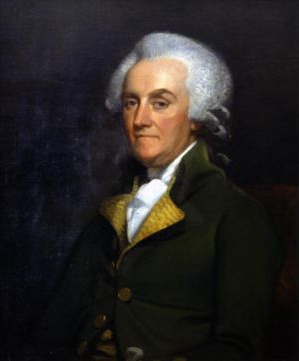
William Franklin painting, attributed to Mather Brown
Still … although by June 19, 1776, the father and son’s differences had long become so strained and irreconcilable, probably neither thought much of the other … I’m going to assume that Benjamin (despite his gout) was in attendance in Congress that day – whether or not he responded, whether he cringed or winced, surely all the delegates had some reaction.
Not just for Benjamin and William, but for themselves as well – as in any civil rupture, families are ripped apart, with time-burnished but submerged drama. That was certainly the case for any number of delegates who could see that their new commitments to independence would also mean the loss of long, deep relationships.
I’ve tried to detour around Wikipedia, but I’ve turned to it in this instance for this portrait of William Franklin. I think he looks strikingly like his father.
Countdown to Semiquincentennial: Number 13, June 19, 1776
By Michael G. Ditmore
0 Comments