
 June 16, 1776 was another Sunday hiatus for Congress. John Adams sat down and wrote a long letter of reply to two letters from his wife Abigail, from May 27 and June 3. If you’ve never read any of the correspondence between Abigail and John, you really should. Much of it can be found, scattered, in the Adams Family Correspondence in the online Adams Papers Digital Edition from the Massachusetts Historical Society (which is the oldest historical society, dating back to 1791).
Here is Abigail’s May 27 letter. And here is the June 3 letter.
And here is John’s June 16 reply – 250 years ago today.
There is so much to consider – the delay in the mails, the information and feeling packed into each letter, how much Abigail was overseeing and keeping tabs on in John’s absence, John’s personal responses – a very different side of John than we what we often encounter (John could be salty, overbearing, wordy). They remind us of a very, VERY different communication world in which people sat down, in moments of quiet, with paper and pen and handwrote with thoughtful reflection to each other – and then had to wait for days and weeks for a reply.
It also serves to remind us of the Sherman Edwards and Peter Stone 1969 musical 1776, for which I have a critique and a commendation. I assume that many people will be watching some version of 1776 this June and July. Although the film version came out in 1972, I never sat down to watch it until probably 15 or 20 years ago. But I have a friend whose family watched it annually for many years.
Maybe I avoided seeing it earlier in part because it just seemed like another Broadway musical – and it mostly is (unlike Lin-Manuel Miranda’s groundbreaking Hamilton). The basic scenario seems like an improbably hard sell for a musical: around 50 white, mostly middle-aged men, mostly cooped in a small assembly room for several days, fussing and agreeing and trying to hammer out independence – by which they meant the Declaration of Independence. Edwards and Stone strove for historical accuracy – but without being overly particular. For instance, Andrew McNair, a recurrent minor character who keeps track of the days by ripping off a calendar page and occasionally contributing unwelcome remarks, is based on actual custodian and bellringer.
But to attract ticket buyers, Edwards and Stone also needed some element to attract women to the audience. They did this with two inventions to include actresses.
One has to do with Thomas Jefferson drafting the Declaration. Here, Edwards and Stone bent matters considerably, giving the idea that Thomas and Martha are newlyweds who long for each other (despite that they’d been married for four years at the time, and that Martha had earlier been widowed) – so that Thomas cannot get started on drafting the Declaration, despite several attempts. Ben Franklin and John Adams secretly manage to get Martha to Philadelphia so that she and Thomas can spend the night together – and so that she can have her own musical performance (the somewhat suggestive “He Plays the Violin”) – and – voila! – Thomas’s creative juices began flowing!
That’s the critique – it’s a silly bit of Broadway musical nonsense, designed to bring in just a bit of sex and a female role, that is far afield of what we know to have happened. To complicate matters, Jefferson actually destroyed all of the correspondence between himself and Martha after her death (following a painful sixth pregnancy within 10 years), so that, very much unlike the rich surviving correspondence between John and Abigail Adams, we have little direct evidence of their relationship.
And John and Abigail Adams’s correspondence brings me to the commendation. Relying on their letters, Edwards and Stone came up with two songs, “Till Then” and “Yours, Yours, Yours” (mislabeled as “Till Then”).
But as for the Declaration’s drafting, we have no real idea where it might have been on Sunday, June 16. It is likely that Jefferson had gotten a start – or got a start on this date – and that he had planned out the basic structure, with the revised grievances against George III already in process and maybe the “British brethren” fragment sketched out.
One final tidbit for today. Adams wrote a second letter to family friend James Warren, catching him up on various tidbits of news, beginning with what he had learned about the Virginia Constitution – not at all by way of Jefferson, but from Patrick Henry (in a letter of May 20). At the end of his letter, Henry somewhat cryptically described the Virginia Convention’s struggles to develop a constitution – and from which Adams inferred that his own April 1776 pamphlet Thoughts on Government would exercise an important influence on the outcome – and thus leaving us with the possibility that both Adams and Jefferson, without suspecting the other’s contribution, influenced the production of the 1776 Virginia Constitution.
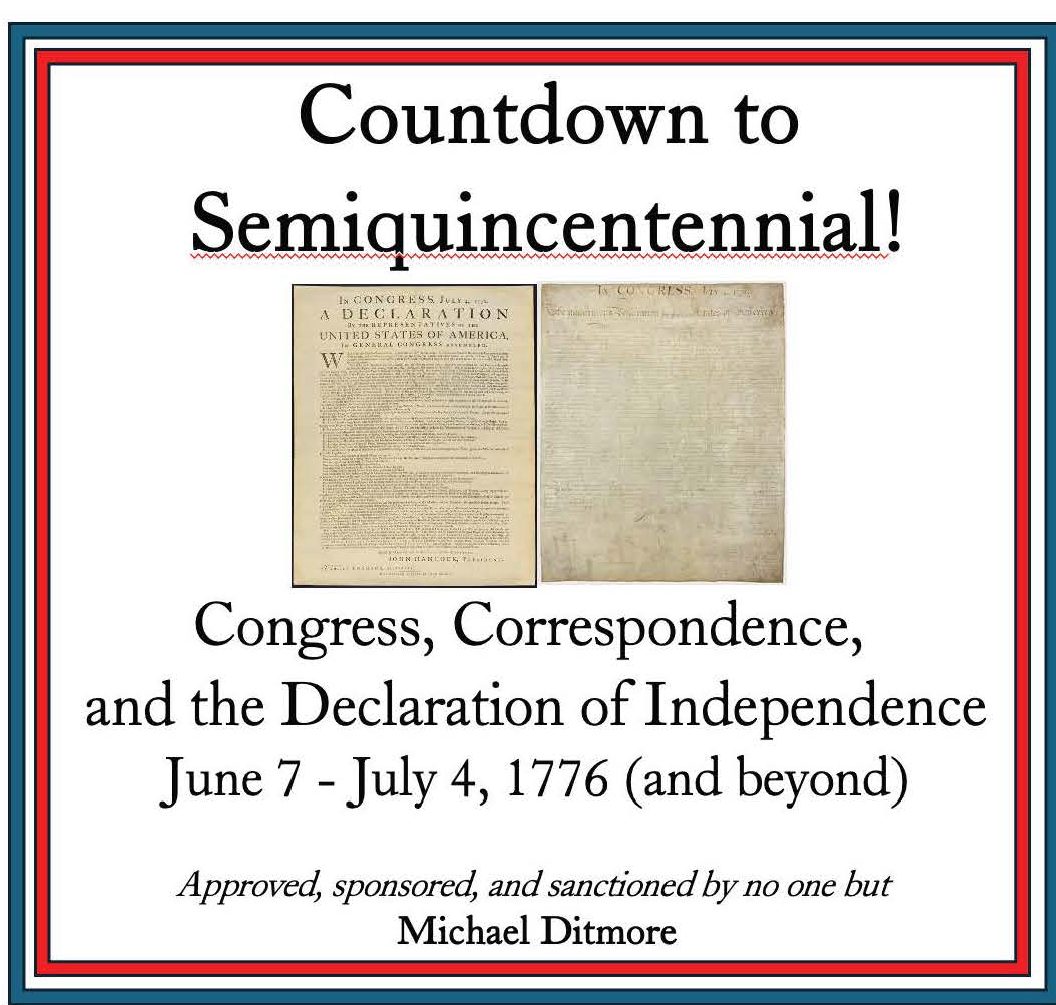
Countdown to Semiquincentennial: Number 10, June 16, 1776
By Michael G. Ditmore
0 Comments