
Maya Angelou’s biography reads like a work of fiction. Angelou published seven autobiographies, three books of essays, and multiple books of poetry, in addition to plays, movies, and cookbooks.
She danced with Alvin Ailey, acted with James Earl Jones and Cicely Tyson, wrote music for Roberta Flack, and was nominated for an Emmy for her role in the TV series Roots. She fought for civil rights with Martin Luther King Jr. and Malcolm X, recited her poem “On the Pulse of Morning” at Bill Clinton’s inauguration, and received the Presidential Medal of Freedom from Barack Obama.
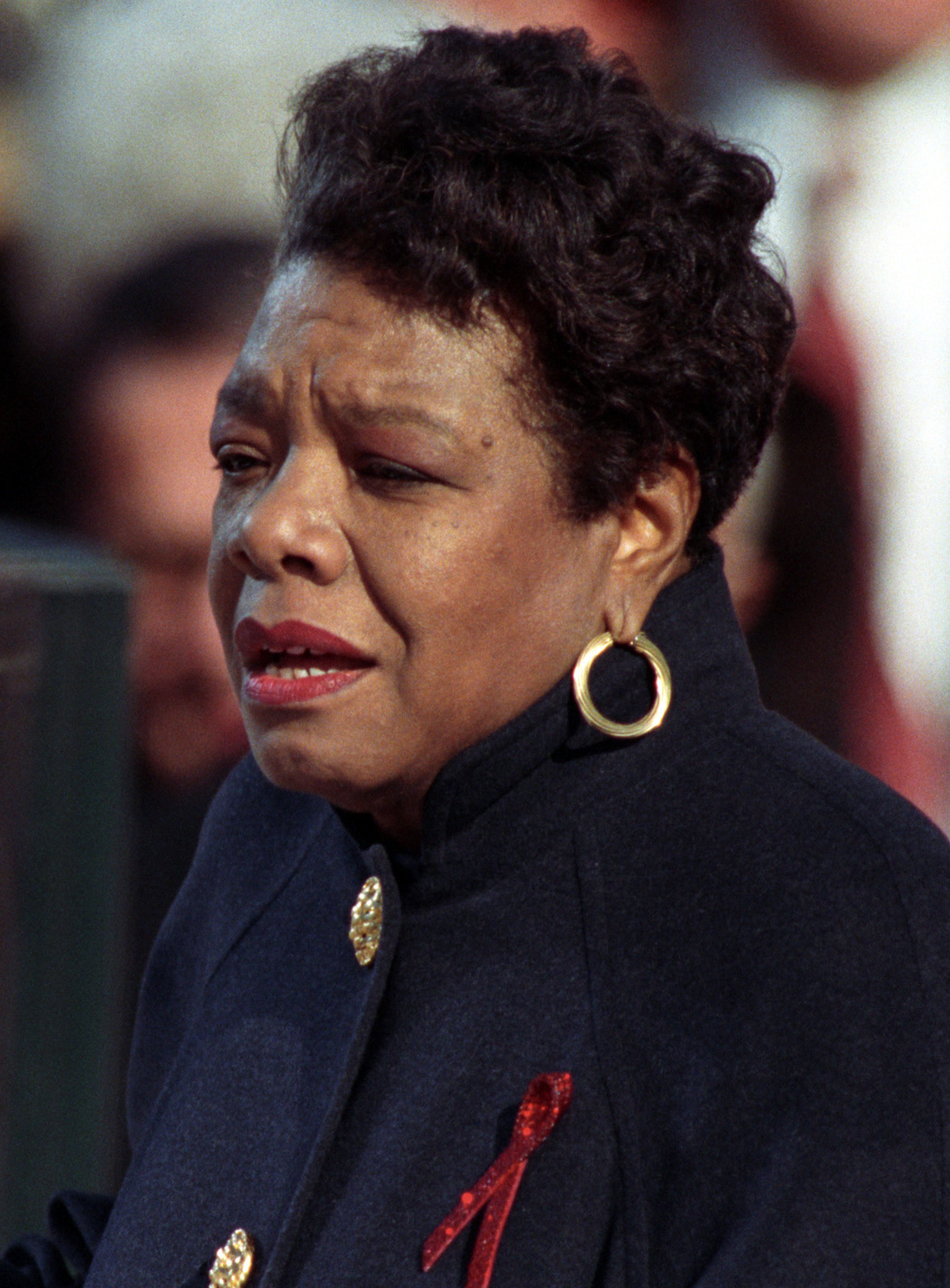
Maya Angelou reciting her poem “On the Pulse of Morning” at President Bill Clinton’s inauguration in 1993. Photo from the William J. Clinton Presidential Library.
Childhood trauma left Maya unable to speak for several years of her life, a period she describes eloquently in her most famous book, I Know Why the Caged Bird Sings, which details her early life. She gave birth to her son at age 16 in 1944 and worked a number of jobs—including some unsavory ones—to support the two of them. After studying dance and acting on a scholarship, Angelou’s performing career took off in the 1950s, and she began to gain some fame for her singing, dancing, and acting. She wrote a movie, Georgia, Georgia, and in 1972 it became the first produced screenplay by a Black woman.
Angelou worked as a journalist for several years in Egypt and Ghana then returned to the U.S. in 1981 and took a professorship of American Studies at Wake Forest University. She also taught at universities in California, Kansas, and Ghana, and toured the country on the lecture circuit until shortly before her death in 2014 at age 86.
It was the lecture circuit that really brought Angelou to my attention. I was the night editor at the newspaper in Austin in 1993, when a reporter was assigned to cover Angelou’s local performance not long after she had gained some attention by performing at Clinton’s inauguration. The normally blasé reporter was starstruck, raving about how inspiring Angelou had been. I was confused—I had assumed this was just a poetry reading. “Oh no,” the reporter told me, “she sang, she danced, she told stories. It’s hard to describe!”
About a year later, I found myself equally awed as I watched Angelou perform for an audience at Pepperdine. She sang, she danced, she recited poetry, she told stories of her life, and she weaved it all together like a beautiful quilt. I went home and read every installment of her autobiography I could find, soaking in her words that told of her struggles and triumphs, faith and fears.
I was thrilled to learn that Angelou would be speaking at the Pepperdine Associates Dinner in 2014 and so disappointed when she canceled the appearance a few days before the event. She passed away not long after that. I was sad to not get the chance to see Angelou perform again but grateful that we still have so many of her words left with us.
Like one of her most famous poems, “Still I Rise.”
0 Comments