
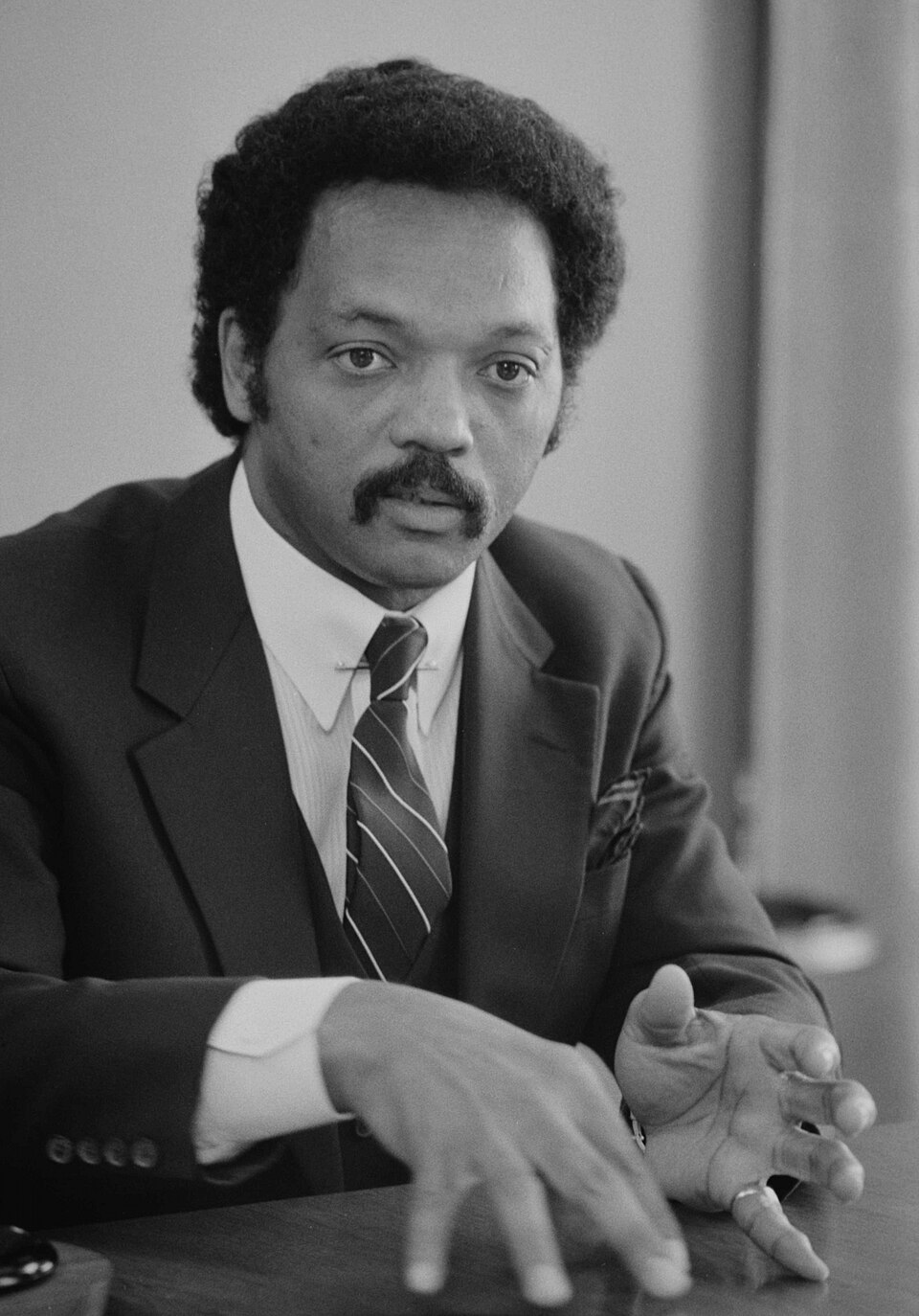
Jesse Jackson in 1983 This image by Warren K. Leffler, is a public domain photo available from the United States Library of Congress’s Prints and Photographs division under the digital ID ppmsc.01277.
Born in 1941, Jesse Jackson grew up in Greenville, South Carolina, and came of age just as the Civil Rights movement was gaining a foothold in the U.S. A star athlete, Jackson earned a scholarship to the University of Illinois but left when he discovered that a Black man would not be given a chance to play quarterback.
So he transferred to North Carolina A&T in Greensboro, N.C., arriving just months after students had made national news by staging a sit-in at a local Woolworth’s lunch counter. While playing quarterback, posting top grades, and serving as student body class president, Jackson also dedicated himself to the Civil Rights efforts. He joined the voting rights march from Selma, Alabama, and worked closely with Martin Luther King, Jr., who dispatched Jackson to Chicago.
Jackson was with King in Memphis in 1968 when King was assassinated, and he spent the rest of his life trying to ensure that King’s legacy—and his work—would never be forgotten. And Jackson did carry King’s work forward throughout his life, becoming one of the most prominent political leaders of any race until his death at age 84 on Feb. 17, 2026.
An ordained Baptist minister, Jackson worked throughout his life in multiple political and grassroots efforts for voting rights, job opportunities, poverty reduction, education, and health care. He founded the Rainbow PUSH coalition, was the first African American to mount a full campaign for president, and received the Presidential Medal of Freedom in 2000. Barack Obama has credited Jackson for laying the groundwork that allowed him to earn the presidency in 2008.
The PUSH coalition says that over the past forty years, Jackson “played a pivotal role in virtually every movement for empowerment, peace, civil rights, gender equality, and economic and social justice.” I don’t think that is an exaggeration.
I saw Jackson up close once when I worked for the Austin American-Statesman in the late 1980s or early 1990s. He was in town for an event — probably the rally at the University of Texas campus where my husband remembers seeing Jackson — and he stopped by the newsroom to meet with the editorial board. When word got around the office that Jackson was there, normally blasé reporters and editors got interested. People started watching the conference room doors and hanging out near the exits. By the time Jackson headed for the elevators, there was no way he was going to slip out unnoticed. A small crowd gathered, pressing in to shake his hand or to express their admiration, while the rest of us stood at our desks and craned to get a closer in-person view of this man that we had seen so often on TV or in news photos.
Jackson paused near the elevators and acknowledged the attention, waving and flashing his famous smile. It was not too unusual for politicians to pass through the newsroom back then but few attracted that kind of attention—but we all knew that Jackson was special, and I have never forgotten that brief glimpse of a man who spent his entire life pushing our country to be better. I am grateful for the sacrifices Jesse Jackson made through his life, for the victories he tallied, and for the changes he helped create.
And if you want to smile today, check out this 1991 Saturday Night Live performance.
0 Comments